How Animal Songs Build Vocabulary in Preschoolers
A parent-friendly guide to joyful early language learning through animal songs |
Introduction: Why Animal Songs Stick With Children

I still remember the first time my youngest confidently shouted, “Cow says moo!” in the middle of the grocery store. Everyone around us smiled. I laughed too, but inside I felt something deeper. That little moment reminded me that language often begins in the simplest, happiest ways.
That “moo” did not come from flashcards or pressure. It came from repetition, music, play, and everyday singing. We had sung animal songs at home, in the car, during playtime, and while looking at animal pictures. Little by little, those sounds became words my child could use with confidence.
As a mother of three and the creator of Kids Songs Learning Hub, I have seen how animal songs can help children build vocabulary in a relaxed and joyful way. Long before toddlers can hold full conversations, many of them can copy animal sounds, repeat simple song phrases, move like animals, and connect words with actions.
In this article, we’ll look at how animal songs build vocabulary in preschoolers, why animal sounds are so useful for early language, and how parents, caregivers, and early years teachers can use animal songs at home or in group learning time
Through parenting, creating children’s songs, and building learning resources for Kids Songs Learning Hub, I have noticed that animal songs often get children talking, moving, and joining in faster than many formal learning activities. They feel playful, familiar, and safe.
Why Animal Songs Work So Well for Preschoolers

Animal songs combine sound, movement, rhythm, imagination, and repetition. That is why they work so well for toddlers and preschoolers. A child can hear the word “cow,” see a picture of a cow, say “moo,” move like an animal, and sing the sound again. That gives the word more meaning than simply hearing it once.
Animal songs are especially helpful because:
Animals are familiar and interesting to young children
Animal sounds are fun and easier to copy than many full words
Movements help children connect language with action
Repetition helps children remember new vocabulary
Pretend play makes learning feel joyful instead of pressured
Parent note: You do not need to turn animal songs into a formal lesson. Sing, pause, let your child copy the sound, and praise the attempt. A simple “moo,” “woof,” or “roar” can be an important early step toward language.
How Music Supports Early Language Skills

Music can support early language because it gives children repeated chances to listen, copy, remember, and respond. Songs slow language down, add rhythm, and make words easier to repeat. For many toddlers, singing feels less pressured than speaking on demand.
When children sing animal songs, they can practise:
Animal names
Animal sounds
Action words such as jump, fly, stomp, hop, and swim
Listening and turn-taking
Memory and repetition
Speech sounds in a playful way
For example, when a child sings “Old MacDonald Had a Farm,” they are not only singing a song. They are learning animal names, matching animals with sounds, waiting for their turn, copying rhythm, and building confidence with repeated words.
How Animal Songs Build Vocabulary Step by Step

1. Repetition builds memory
Animal songs repeat naturally. The same words, sounds, and patterns come back again and again. That repetition helps children remember new vocabulary without feeling like they are being tested.
2. Animal sounds come before full words
For some toddlers, “woof” may come before “dog,” and “moo” may come before “cow.” That is still meaningful language practice. Animal sounds are short, fun, and easy to copy.
3. Movement anchors meaning
When a child hops like a frog, flaps like a bird, or stomps like an elephant, the word becomes connected to the body. This helps children understand and remember what the word means.
4. Songs create emotional safety
Children are often more willing to try sounds during a song than when an adult asks them to “say the word.” Music lowers pressure and gives children a safe, playful way to participate.
5. Pretend play makes words useful
Animal songs naturally lead into pretend play. A child can become a lion, duck, cow, or bird. This gives them a reason to use the words again during play.
Real-Life Example: How Music Transforms Learning

One preschooler in my class barely spoke during circle time. But when we sang “The Animal Action Song,” she suddenly roared like a lion loudly and proudly.
That moment changed everything.
Soon, she began using words during play. Her confidence grew because music gave her a safe entry point into language.
How Parents Can Use Animal Songs at Home

You do not need a special instruments or training, just the will to do it.
1. Sing During Daily Routines
Bath time → “Five Little Ducks”
Clean-up time → “The Animals on the Farm”
Car rides → Animal guessing songs
2. Add Movement
Encourage hopping, crawling, or clapping to match animals.
3. Repeat Favorites
Repetition builds confidence and mastery.
4. Follow Your Child’s Lead
If your child loves lions, lean into lion songs!
Printable Activity: “My Animal Sound Book”

To make these animal songs easier to use at home or in preschool learning time, add a free Animal Songs Vocabulary Builder Pack. This printable helps children match animals with sounds, colour animal pictures, act out movements, and build early vocabulary through music and play.
Inside the printable, include:
✓ Animal sound matching cards
✓ “Cow says moo” vocabulary pages
✓ Animal movement cards
✓ My animal sound book pages
✓ Sing and colour animal activity sheets
✓ Animal guessing game
✓ Little Animal Song Star certificate
You can download it from the Free Preschool Printables Library and use it alongside the songs and activities in this article.
Helpful Related Resources
If your child enjoys animal songs, read “Noah’s Ark Song and Animal Activities for Kids” for Bible-based animal sounds, matching, counting, and movement ideas.
For speech and language support through music, read “Fun Songs to Help Toddlers Talk: Boost Speech and Language Development.”
For more nursery rhyme learning, visit “Best Nursery Rhymes for Toddlers: 20 Songs That Support Early Learning.”
You can also visit the Free Preschool Printables Library for animal activities, song trackers, nursery rhyme pages, and preschool learning printables.
Why Original Songs Matter

I compose creative songs such as "Zoomy the Magic Bus" at Kids Songs Learning Hub, as kids learn more effectively when they can connect with the characters.
Original songs:
Build emotional attachment
Reinforce consistent vocabulary
Support imaginative play
Kids usually learn more quickly when they have an emotional bond with the characters that are teaching them.
External Research That Supports Music Learning
Here are trusted sources supporting music-based learning:
Harvard Center on the Developing Child
Zero to Three – Early Learning Resources
American Academy of Pediatrics (AAP)
These groups always say that music is a great way for young children to learn.
Common Questions Parents Ask
What age should children start listening to animal songs?
As early as infancy. Babies respond to rhythm and melody long before speech develops.
How often should we use music?
Every day, even if it's just for a little time. Five minutes of singing can have a bigger effect than 30 minutes of watching TV.
What if my child doesn’t sing along?
That’s okay. Listening is learning. Participation comes in stages.
How to Use Animal Songs in Class as a Teacher

Educators use animal songs for:
Morning circle
Transitions
Language development
Classroom management
Group singing builds connection and confidence — especially for shy learners.
Final Thoughts: Why Animal Songs Matter
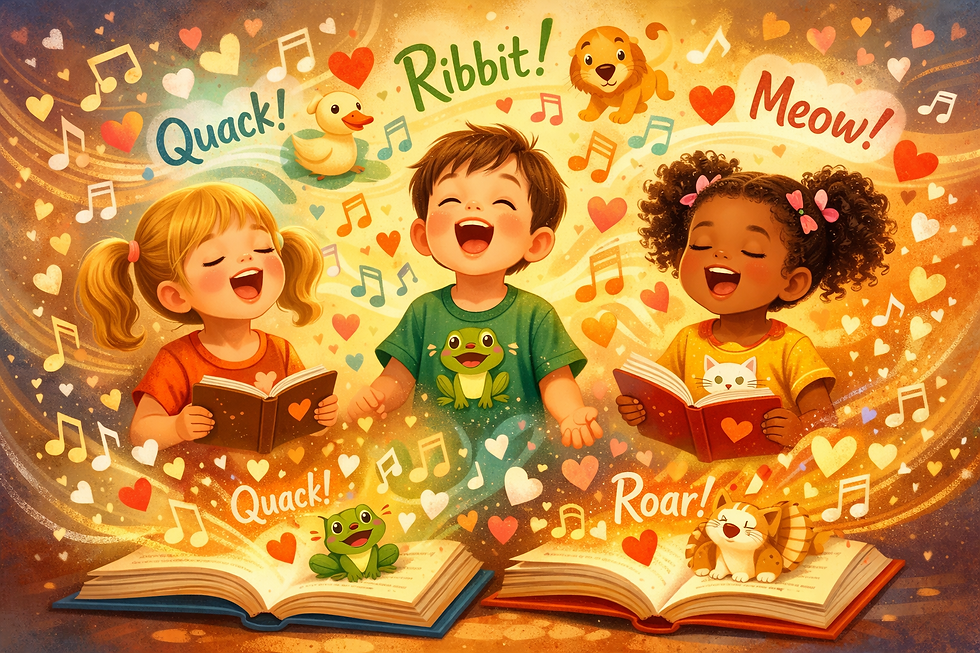
Animal songs are more than just a fun thing to do. They are a strong way to build language, confidence, and connection.
I've learned this truth from all the years I've taught kids and made songs for them:
Children don’t just learn through songs — they grow through them.
Whether at home or in the classroom, music opens doors that words alone cannot.
🎵 Explore a lot More from Kids Songs Learning Hub
Printable Learning Activities
About the Author
Janerine Watson is the founder of Kids Songs Learning Hub, a mother of three, and a BSc Health and Social Care graduate. She creates music-based learning resources, children’s songs, printable activities, and parent-friendly guides that help toddlers and preschoolers learn through rhythm, repetition, movement, vocabulary, routines, and play. Through parenting and creating early learning content, Janerine has seen how animal songs can support speech sounds, listening, confidence, vocabulary, and joyful connection.
Educational Disclaimer
This article is for educational and family learning purposes only. Animal songs, movement games, printable activities, and music-based learning ideas can support vocabulary, listening, speech sounds, and playful learning, but every child develops at their own pace. This content is not a substitute for professional advice. If you have concerns about your child’s speech, hearing, language development, behaviour, or learning, speak with a qualified health visitor, pediatrician, speech and language therapist, or early years professional.


Comments