Safe Sleep for Newborns: A Parent-Friendly Guide

Bringing a newborn home can feel beautiful, emotional, and overwhelming all at once. You may be tired, sore, feeding around the clock, and trying to remember every piece of advice you were given before leaving hospital.
One of the biggest questions many new parents ask is simple: Where should my baby sleep, and how can I make it as safe as possible?
Safe sleep is not about judging tired parents. It is about reducing avoidable risks and helping babies sleep in the safest place available for every nap and night time sleep.
The safest sleep setup is simple, but not always easy when you are exhausted: baby on their back, in their own clear, flat, firm sleep space, with no loose bedding, pillows, toys, bumpers, or sleep positioners. In the UK, NHS and The Lullaby Trust advise that babies sleep in the same room as you for at least the first 6 months, but in their own cot, crib, or Moses basket.
As a mother of three and founder of Kids Songs Learning Hub, I know how hard the newborn stage can feel. This guide shares parent-friendly safe sleep reminders using trusted guidance from organisations such as NHS, The Lullaby Trust, CDC, and the American Academy of Pediatrics.
Important note
This article is for general parent education only. It is not medical advice and it cannot cover every baby’s individual needs. If your baby was premature, has reflux, breathing concerns, feeding difficulties, medical needs, or you are unsure what is safest, speak with your midwife, health visitor, GP, paediatrician, or another qualified health professional.
Why Safe Sleep Matters
Babies are safest when they sleep in a clear, flat, firm, separate sleep space. Safe sleep guidance is designed to reduce the risk of sudden infant death syndrome, accidental suffocation, overheating, and unsafe sleep situations.
Safe sleep does not mean you are cold or distant. It means you are giving your baby the safest sleep environment you can, even when you are tired.
The Main Safe Sleep Rules for Newborns
✅1. Place baby on their back for every sleep

Place your baby on their back for naps and night time sleep. This is one of the clearest safe sleep messages from NHS, CDC, The Lullaby Trust, and AAP guidance.
If your baby has reflux or another health concern, do not change their sleep position without medical advice. Speak with your midwife, health visitor, GP, or paediatrician.
✅ 2. Use a firm, flat, clear sleep space

Your baby’s sleep space should be firm, flat, and clear. Use a cot, crib, bassinet, Moses basket, or travel cot that is suitable for baby sleep, with a firm mattress and fitted sheet.
Keep the sleep space free from:
Pillows
Loose blankets
Duvets or quilts
Cot bumpers
Soft toys
Sleep positioners
Wedges or inclined sleepers
Loose muslins or cloths
A clear cot can look plain, but plain is safer.
🔗 Check your crib: CPSC Crib Safety Guidelines
✅ 3. Share a room, not a sleep surface

For at least the first 6 months, the safest place for your baby to sleep is in the same room as you, but in their own separate sleep space. This applies to daytime naps as well as nighttime sleep where possible.
Avoid sleeping with your baby on a sofa, armchair, recliner, or soft surface. These are especially unsafe places for a baby to sleep with an adult.
✅ 4. Keep baby at a comfortable temperature

Babies should not get too hot during sleep. NHS and The Lullaby Trust advise keeping the room around 16 to 20°C where possible. Use light bedding or a well-fitting baby sleep bag, and remove hats and extra outdoor clothing when indoors.
Check your baby’s chest or the back of their neck. If they feel hot, sweaty, or flushed, remove a layer. Do not judge temperature only by hands or feet, as they can feel cooler.
✅ 5. Use a baby sleep bag or light bedding safely

A well-fitting baby sleep bag can be a safer option than loose blankets if it is the right size, weight, and tog for the room temperature. Follow the manufacturer’s instructions and make sure your baby cannot slip down inside it.
If using a blanket, keep it lightweight and tucked in below shoulder level, with baby’s feet near the foot of the cot. Do not use duvets, quilts, weighted blankets, or heavy bedding for newborn sleep.
6. Keep baby away from smoke
Smoke exposure increases risk for babies. Keep your baby’s home, car, and sleep space smoke-free.
7. Consider a dummy or pacifier if it suits your baby
AAP guidance says parents can consider offering a dummy or pacifier at nap time and bedtime. If you are breastfeeding, ask your midwife, health visitor, or infant feeding support team about timing if you are unsure. Do not attach a dummy to cords, ribbons, clips, or anything loose during sleep.
8. Make every sleep count
Safe sleep guidance applies to night time sleep, naps, travel naps, visits to family, and unexpected moments when baby falls asleep. If your baby falls asleep somewhere not designed for safe sleep, move them to their clear, flat, firm sleep space as soon as you can.
Common Safe Sleep Myths

My baby sleeps better on my chest, so it must be safe.”
Many babies love sleeping close to a parent, but sleeping on an adult’s chest while the adult is also asleep can be unsafe, especially on a sofa, armchair, or soft surface. If you feel sleepy, place baby in their own safe sleep space before you fall asleep.
“A soft nest or pillow makes the cot more comfortable.”
Newborns do not need pillows, nests, bumpers, positioners, or soft bedding. A firm, flat, clear sleep space is safer.
“My baby has reflux, so side or tummy sleeping is safer.”
Do not change baby’s sleep position because of reflux without medical advice. Safe sleep guidance still recommends back sleeping unless a qualified medical professional tells you otherwise.
“A hat keeps baby warm during sleep.”
Babies should not usually wear hats indoors or while sleeping, because they can overheat. Remove hats and outdoor clothing once indoors.
“If I am awake beside the baby, the sofa is fine.”
Sofas and armchairs are risky places for babies to sleep, especially if an adult becomes drowsy. If you feel sleepy, move baby to their own sleep space.
🔗 More myths: AAP Safe Sleep FAQs
White Noise and Newborn Safe Sleep
White noise is not required for safe sleep. Some families use low, steady background sound to help mask household noise, but it should be used carefully.
If you use white noise:
Keep the device outside the cot or Moses basket
Place it as far away from baby as practical
Use the lowest helpful volume
Avoid placing phones, tablets, speakers, or cords near the sleep space
Avoid bright screens near baby’s cot
Turn it down or off if it seems too loud or if your baby seems unsettled
Do not claim that white noise makes sleep safer, improves breathing, or reduces stress hormones. It is simply a settling tool some families choose to use.
Swaddling and Safe Sleep

Some parents swaddle newborns, but swaddling must be done carefully. AAP guidance says swaddled babies should always be placed on their backs, and swaddling should stop as soon as baby starts showing signs of trying to roll. NIH also says swaddling does not reduce SIDS risk and weighted swaddles or weighted blankets are not recommended for babies.
If you swaddle:
Use a lightweight fabric
Keep baby on their back
Keep hips free to move
Keep the swaddle away from baby’s face
Do not use weighted swaddles
Stop when baby shows signs of rolling
Ask your midwife, health visitor, or paediatrician if you are unsure
Safe Sleep Checklist for Newborns
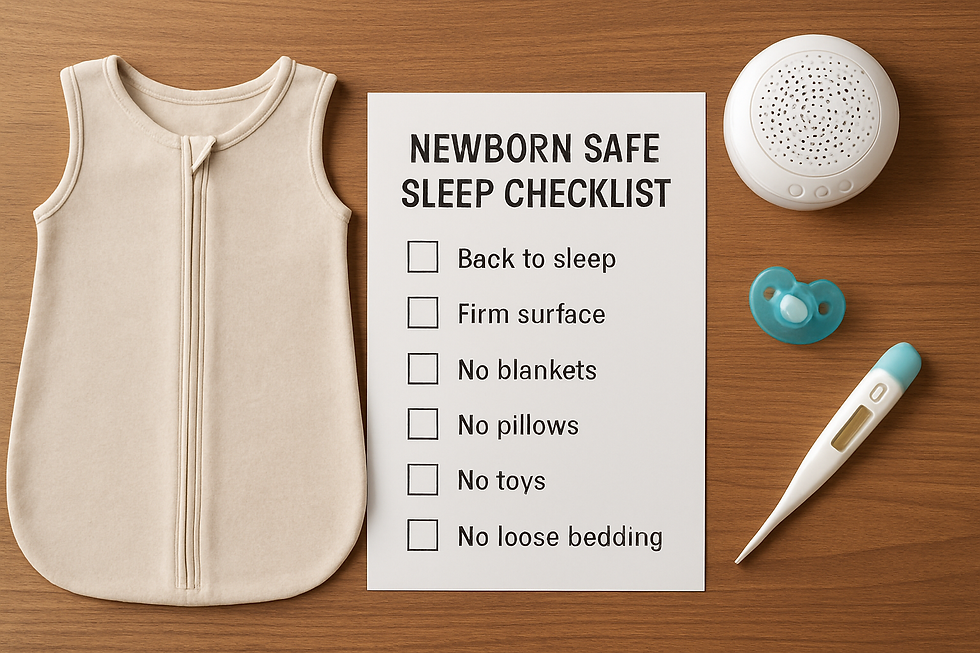
Use this simple checklist every time you put your baby down to sleep:
✓ Baby is placed on their back
✓ Baby is in their own cot, crib, Moses basket, bassinet, or travel cot
✓ Mattress is firm and flat
✓ Fitted sheet only
✓ No pillows
✓ No loose blankets
✓ No toys or soft items
✓ No cot bumpers
✓ No sleep positioners, wedges, or inclined sleepers
✓ Baby is not too hot
✓ No hat indoors or during sleep
✓ Baby sleeps in the same room as parent for the first 6 months
✓ Sleep space is smoke-free
✓ No cords, screens, or devices near the cot
Free Printable: Newborn Safe Sleep Checklist
To make this article easier to use, add a printable Newborn Safe Sleep Checklist. This can be placed near the changing table, cot, nursery door, or parent bedside area as a gentle reminder.
Inside the printable, include:
✓ Back to sleep reminder
✓ Clear cot checklist
✓ Room-sharing reminder
✓ Temperature check
✓ No loose bedding reminder
✓ Safe swaddling reminder
✓ White noise safety note
✓ Questions to ask your midwife, health visitor, GP, or paediatrician
Helpful Related Resources
For gentle bedtime routines, read “How to Create a Peaceful Bedtime Routine With Sleep Music and Songs.”
For baby sleep music safety, read “Soothing Sleep Music for Babies.”
For parent-friendly baby routine ideas, visit the Free Preschool Printables Library.
Final Thoughts
Safe sleep can feel emotional when you are exhausted and your baby wants to be close. It is normal to want comfort, rest, and reassurance.
But a safe sleep space is one of the most important things you can prepare for your newborn. Baby on their back. Clear cot. Firm, flat mattress. Same room, separate sleep space. No loose bedding. No pillows or toys.
You do not have to be perfect. You just need to return to the safest setup every time you can. One safe sleep at a time.
Sources and useful guidance
About the Author
Janerine Watson is the founder of Kids Songs Learning Hub, a mother of three, and a BSc Health and Social Care graduate. She creates music-based learning resources, children’s songs, printable activities, and parent-friendly guides that help toddlers and preschoolers learn through rhythm, repetition, movement, routines, and play. Through parenting and her background in health and social care, Janerine shares practical ways families can make everyday routines, baby care reminders, and family learning moments more realistic, gentle, and easier to repeat.
Baby Sleep and Safety Disclaimer
This article is for general educational and parenting information only. It is not medical, paediatric, midwifery, health visiting, sleep consultancy, emergency, or professional safety advice. It should not replace guidance from your midwife, health visitor, GP, paediatrician, NHS 111, emergency services, or another qualified health professional.
Every baby is different. Premature babies, babies with low birth weight, reflux, breathing concerns, feeding difficulties, medical needs, illness, fever, or developmental concerns may need individual advice. Always follow the guidance given by your baby’s healthcare team.
If your baby has breathing difficulty, turns blue or grey, is unusually floppy, has a fever, is not feeding, is difficult to wake, or you are seriously worried, seek urgent medical help. In an emergency, call emergency services.
Sleep products, mattresses, cots, cribs, bassinets, Moses baskets, baby sleep bags, swaddles, monitors, and sound machines should be checked carefully before use. Do not rely on product marketing claims alone. Follow current safer sleep guidance from trusted health organisations.


Comments