Summer Bucket List for Kids: 25 Musical & Creative Activities Before School Starts
Updated: Jul 1
A summer bucket list does not need to be expensive, complicated, or packed with big days out. Some of the best summer memories come from simple things: singing in the garden, making homemade instruments, painting to music, camping in the living room, picking fruit, making ice lollies, recording a funny family song, or watching the sky change colour at sunset.

In our family, the summer bucket list started by accident. One year, on the last day of term, my child came home with a crumpled piece of paper titled “Things I Want to Do This Summer.” The list included ice cream, teaching Dad a song, and “something magic.” We stuck it on the fridge, ticked things off slowly, and by September that little list had become the story of our summer.
That is why I love summer bucket lists for children. They give the holidays a gentle shape without turning them into a strict schedule. Children can help choose the activities, see what is coming next, and look back at what they have done.
This guide includes 25 musical and creative summer activities for kids, split into five simple categories: music and performance, outdoor adventures, creative making, food and singing, and memory-making. You will also find a printable bucket list checklist, a week-by-week summer planner, practical tips, FAQ, and safety reminders for families.
Why a Summer Bucket List Works for Kids and Parents

A summer bucket list is not a parenting test. It is not a curriculum. It is not something you have to finish perfectly. It is simply a shared family list of ideas you want to enjoy together.
A good summer bucket list can help children:
Feel involved in choosing family activities
Look forward to simple moments
Practise creativity, music, movement, language, and confidence
Spend more time outdoors when it is safe
Create memories they can talk about later
See summer as a story with beginning, middle, and ending
The music part matters too. Songs help children remember routines, join in with confidence, and connect activities with feelings. A summer with songs often becomes easier for children to retell because each activity has a sound, rhythm, or lyric attached to it.
Important summer safety note
Always adapt these activities for your child’s age, needs, weather, allergies, abilities, and energy level. Supervise children closely around water, cooking, scissors, small objects, outdoor spaces, pets, insects, and unfamiliar plants. In hot weather, use shade, suitable clothing, hats, sunscreen, and regular drinks. For food activities, prepare ingredients safely and cut foods into age-appropriate pieces.
🎵 Category 1: Music & PerformanceFive activities that put music at the centre — performing, creating, and sharing songs in ways that build confidence, memory, and joy. Activities 1–5 |
☀️ Activity 1
🎤 The Big Summer Concert
This is the anchor of the whole bucket list the thing everything else can build towards. At the start of summer, announce that on the final weekend before school, your family will host a Summer Concert. Children choose their songs, design a poster, decide on a costume (there will absolutely be a costume), write a programme, and rehearse over the coming weeks. On the night: fairy lights, a dedicated "stage" area, an audience of family members who clap with genuine enthusiasm, and a performer who walks away knowing they made something happen from beginning to end.
🎵 Let children choose entirely their favourite songs, in their chosen order. The setlist is theirs.
🎤 You need: A space, willing family, a DIY microphone (optional but transformative), fairy lights.
💡 Help your child make a concert programme a folded piece of paper with song titles. They've just created their first piece of purposeful writing. Frame it afterwards.
🎯 Goal-Setting❤️ Confidence🧠 Memory🔢 Sequencing📖 Early Writing
Activity 2
🥁 Make a Homemade Instrument
Choose one instrument to make together a shaker from a sealed bottle of dried rice, a guitar from a tissue box and rubber bands, a drum from an empty tin and a stretched balloon, a pan flute from different lengths of drinking straw. Research how it works, build it, decorate it, and then play it. This is science (how sound is made), maths (how length affects pitch), art (how to decorate it), and music education all in one afternoon. The finished instrument earns a place in the Summer Concert.
🎵 Play along to any favourite song once the instrument is built. Old MacDonald works for almost any homemade percussion.
🎨 You need: Depends on instrument rice + bottle, tissue box + bands, tin + balloon. All household items.
💡 Let your child name their instrument and give it a personality. "This is Gerald the Shaker." Ownership and character make children return to activities again and again.
🔬 Sound Science🎨 Making🥁 Rhythm🧠 Creative Thinking
☀️ Activity 3
🎬 Film a Music Video
Choose a favourite song, choreograph a simple routine together, dress up in whatever feels right, and film a music video on your phone. Watch it back. Watch it again. The combination of performance, choreography, costume, and viewing is extraordinarily rich: children are learning about narrative structure (a song has a beginning, middle and end), about how they look and sound to other people (a powerful self-awareness milestone), and about the joy of making something they can share. Post it to a private family group if you have one the comments from grandparents will sustain them for a week.
🎵 Any song your child loves and knows by heart. The more enthusiastically they already sing it, the better the video.
📱 You need: A phone with a camera. A willing performer. A costume box if you have one.
💡 Let your child direct as well as perform "stand here, move like this, start when I count to three." Directing is leadership, spatial reasoning, and communication all at once.
🎭 Performance🧠 Self-Awareness📖 Narrative❤️ Confidence
☀️ Activity 4
🎼 Write an Original Song
This one sounds ambitious and is actually very simple. You do not need to write music. You need a tune your child already knows Twinkle Twinkle, The Wheels on the Bus and new words about something they love. "Twinkle twinkle little dog, sitting on a log..." The words can be nonsense, the rhymes imperfect, the subject entirely up to them (dinosaurs, pizza, their best friend, the family cat). Write the lyrics down and keep them. This is creative writing, phonological awareness, and musical composition and it takes twenty joyful minutes.
🎵 Use Twinkle Twinkle or Wheels on the Bus as the base melody both accept almost any new lyrics.
📝 You need: Paper, a pencil, and a child with opinions about what they love. Which is every child.
💡 Perform the original song at the Summer Concert. A child who sings a song they wrote is a child experiencing authorship for the first time. That is a significant moment.
✍️ Creative Writing🔤 Phonological Awareness🎨 Composition❤️ Self-Expression
☀️ Activity 5
🎧 Host a Family Listening Party
Choose an album together it can be a children's album, a family favourite, or something completely new that nobody has heard before. Sit together, no other screens, and listen to the whole thing front to back. Talk about each track. What do you like? What does it make you think of? What would you call this song if it didn't have a name? Active, focused listening is a skill that is increasingly rare and increasingly valuable. This activity builds it in the most enjoyable format possible with biscuits, if you play it right.
🎵 Our recommendation: any Kids Songs Learning Hub playlist, a classic children's album like The Singing Kettle, or a family favourite that means something to you.
🎧 You need: A speaker, an album, and an agreement to really listen. Biscuits optional but recommended.
💡 Ask each family member to choose their favourite track after listening. Then make a "family chart" of the results. Voting, tallying, and displaying results is maths, social skills, and shared joy combined.
👂 Active Listening🗣️ Discussion❤️ Family Bonding🎨 Musical Taste
Outdoor Safety Reminder
Outdoor summer activities are wonderful, but keep them flexible and safe. Choose cooler parts of the day when possible, use shade, hats, suitable clothing, and sunscreen, and keep drinks nearby. Always supervise children near ponds, paddling pools, rivers, lakes, beaches, buckets of water, or garden water play. If the weather is too hot, rainy, windy, or unsafe, move the activity indoors or save it for another day.
🌿 Category 2: Outdoor AdventuresFive activities that take learning outside into gardens, parks, puddles, and the evening sky. Activities 6–10 |

The outdoors is the richest classroom available to children this summer — and it's free, it's open, and it's full of things worth singing about.
🌿 Activity 6
🌿 Go on a Singing Nature Walk
Walk a familiar route park, woodland, canal path but with one rule: every time you notice something interesting (a bird, an unusual cloud, a dog that looks exactly like a celebrity), you must make up two lines of song about it. No preparation. No correct answers. Just walk and sing and notice. This sounds whimsical and is in fact one of the richest vocabulary-building exercises available, because it requires children to observe, articulate, and find words for what they see spontaneously, in real time, set to music. The songs don't have to be good. They have to be genuine.
🎵 No set song make up melodies as you go. Use Twinkle Twinkle as a base if you need a starting structure.
👟 You need: Comfortable shoes, somewhere to walk, and an agreement to be ridiculous together.
🗣️ Vocabulary👁️ Observation🎨 Spontaneous Creativity🌍 Nature Knowledge
🌿 Activity 7
☀️ Watch a Sunrise or Sunset Together
Choose one morning for an early alarm, or one evening for staying up past bedtime, and watch the sky change. Bring a blanket. Sit outside if you can. Watch the colours shift from deep blue through gold through pink. Name the colours as they appear. Sing Twinkle Twinkle as the first stars arrive, or Day is Done as the sun goes below the horizon. The magic of this activity is its simplicity: the sky does the work. You just have to be there to see it. Children who have watched a sunrise with a parent carry that memory with an unusual vividness. It feels significant because it is.
🎵 "Twinkle Twinkle Little Star" as stars appear · "Golden Slumbers" · "Here Comes the Sun" for a sunrise · "Day is Done" for sunset.
🌅 You need: A sky with a view, a blanket, and either an early alarm or permission to stay up late. Warm drinks help.
🌅 Nature Wonder🎨 Colour Vocabulary😌 Mindfulness❤️ Shared Memory
🌿 Activity 8
🐛 Go on a Minibeasts Hunt
Arm your child with a magnifying glass and a jar and spend a morning finding minibeasts worms, beetles, woodlice, ants, snails, spiders, caterpillars. Name each one, observe it carefully, make up a fact about it (real or invented you can look up which is which later), and release it where you found it. This is science, vocabulary, and the foundational naturalist's skill of paying close attention to small things. After the hunt, sing about what you found. The sillier the song, the better the memory.
🎵 "There's a Worm at the Bottom of the Garden" · "The Ants Go Marching" · Make up a song for any creature that doesn't have one yet.
🔍 You need: A magnifying glass, a jar with air holes, a garden or park. A wildflower area is ideal.
🔬 Science Curiosity🗣️ Nature Vocabulary👁️ Observation❤️ Care for Living Things
🌿 Activity 9
💧 Have a Safe Garden Water Play Challenge
A summer water play challenge can be just as exciting as a water fight, but it should always be supervised and kept safe. Use small buckets, sponges, cups, or gentle water sprays, and keep the game suitable for your child’s age and confidence.
Try simple challenges such as filling a small bucket, counting sponge squeezes, singing a rainy-day song, or seeing who can move water from one bowl to another without spilling too much.
Song idea: Sing “Rain Rain Go Away” while splashing, or use counting songs for filling and emptying buckets.
You need: Small buckets, sponges, cups, old clothes, towels, and close adult supervision.
Safety note: Empty buckets, paddling pools, and water containers straight after use. Stay close enough to reach your child at all times, and never leave children unsupervised near water.
💦 You need: Water pistols, buckets, a hose, old clothes, warm weather, and no subsequent plans that require dry hair.
🏃Skills supported: Gross Motor play🤝 turn-taking😂 sensory play🔢 Counting, and shared laughter
🌿 Activity 10
🌙 Camp in the Garden (or Living Room)
Put up a tent, or build a fort from sofa cushions and bedsheets, and spend a night "camping" with torches, hot chocolate, sleeping bags, and a storytelling session that ends with songs. If the garden is available and the weather holds, the sounds of a summer night (owls, foxes, the wind in the trees, the last birds settling) are extraordinary for children who rarely hear them. If the living room fort is the option, it is no less magical. The songs that close a camping night slow, warm, sung quietly in the dark are some of the most powerful musical memories a childhood can hold.
🎵 "Twinkle Twinkle" · "Hush Little Baby" · "You Are My Sunshine" · Any slow, familiar song sung very quietly in the dark.
⛺ You need: A tent or large sheet, sleeping bags, torches, hot chocolate. The garden is ideal; the living room is perfect.
🌙 Night Nature😌 Calm & Wonder❤️ Family Bonding🎭 Storytelling
🎨 Category 3: Creative MakingFive activities that put making at the centre with paint, clay, fabric, collage, and the rich mess of genuine creative play. Activities 11–15 |

Messy, joyful, entirely process-led creative making is one of the most developmentally rich things a child can do all summer.
🎨 Activity 11
🖌️ Paint to a Full Album
Put on a children's album or a family favourite and paint freely while listening to the whole thing. No subject, no instruction, no "what are you making?" Just paint and music, from the first track to the last. Change brushes, change colours, change paper if you run out. Notice how the painting changes as the music changes. This is the longest, most absorbing, most genuinely free creative activity on this list and the paintings produced are often the most extraordinary, because nobody was trying to make anything in particular.
🎵 A full album from Kids Songs Learning Hub · Classical music also works beautifully try Vivaldi's Four Seasons for a seasonal theme.
🎨 You need: Paint, paper, brushes, old clothes, music. A garden or easily-wipeable surface is ideal.
🎨 Free Creative Expression👂 Active Listening🙌 Fine Motor😌 Flow State
🎨 Activity 12
📚 Make a Summer Storybook
Fold five or six pieces of paper in half and staple them you have a book. Your child draws the pictures (one event per page from the summer so far), you write their words underneath each one, and the result is a handmade picture book about their own life. Read it together. Then read it to anyone who will sit still. This is early literacy, narrative sequencing, and the deeply important message that their own experiences are worth telling that their own life is interesting enough to be in a book. Because it is. All of it is.
🎵 Read the finished book aloud and sing the bits that mention songs. If they drew the water fight, sing Rain Rain Go Away over that page.
📄 You need: Paper, stapler, crayons or pencils. Twenty minutes of your focused attention for the writing.
📖 Early Literacy🗣️ Narrative🎨 Illustration❤️ Self-Worth
🎨 Activity 13
🏺 Clay or Playdough Sculpting Session
Air-dry clay is available inexpensively from most craft shops and produces results that last. Give your child a lump and a simple brief: make something from a song you love. The five little ducks. The bus. A monkey on a bed. The limitation of working from a known song actually enhances creativity there's a goal, but how to reach it is entirely open. When the sculptures dry, paint and display them. They become three-dimensional illustrations of the songs your family loves.
🎵 Choose the sculpting subject from your favourite songs Five Little Ducks, Incy Wincy Spider, Old MacDonald's animals.
🏺 You need: Air-dry clay or homemade playdough, a flat surface, optional sculpting tools (a fork and a blunt pencil are fine).
🙌 Fine Motor🎨 3D Thinking🎵 Song Connection🧠 Creative Problem-Solving
🎨 Activity 14
🪡 Design a Summer T-Shirt
Buy a plain white t-shirt and fabric pens both are inexpensive and let your child decorate it with their summer so far. Favourite moments, favourite songs, favourite creatures found. They can write, draw, or do both. The finished t-shirt is a wearable scrapbook something they can literally put on their body and carry into September. Wear it on the last day of summer. Photograph it. It is a remarkable document of what this particular summer meant to this particular child.
🎵 Encourage them to include a lyric from their favourite summer song even one word. "Quack." "Round and round." Whatever it is.
👕 You need: A plain white or light-coloured t-shirt (car boot sales are a good source), fabric pens or fabric paint.
🎨 Design Thinking✍️ Writing for Purpose❤️ Identity & Expression🧠 Memory
🎨 Activity 15
🌸 Build a Nature Mandala
Collect natural materials on a walk leaves, petals, pebbles, seeds, twigs and arrange them into a circular mandala pattern on the ground or on a large piece of dark card. Work from the centre outward. Name the colours and textures as you place each piece. Photograph the finished mandala before it is dispersed by the wind (or a sibling). Play a calm, flowing piece of music while you work. The combination of meditative making, colour sorting, symmetry, and natural material builds spatial awareness, fine motor skills, and a rare quality of focused calm that children carry into the rest of the day.
🎵 "I Can Sing a Rainbow" as you sort by colour · calm instrumental music while arranging · any nature song from Kids Songs Learning Hub.
🌸 You need: Natural materials collected on a walk. Dark card or the ground itself. No glue let it be temporary.
🔢 Pattern & Symmetry🎨 Colour Sorting😌 Focused Calm🌍 Nature Connection
Food and Cooking Safety Reminder
Children can enjoy helping with food activities, but adults should handle knives, hot ovens, hobs, boiling water, raw ingredients, and allergy decisions. Always supervise children while eating. Cut foods into safe, age-appropriate pieces and avoid hard, sticky, chewy, large, or round foods for young children unless they are safely prepared. Adapt every recipe for allergies, chewing ability, swallowing skills, and your family’s dietary needs.
🍓 Category 4: Food & SingingFive activities that combine cooking, eating, and music because food and song are two of the most ancient, universal forms of human joy. Activities 16–20 |
🍓 Activity 16
🍰 Bake Something Together — With a Song for Every Step
Choose a simple recipe banana bread, flapjacks, a tray of biscuits and assign a song to each stage. A counting song for measuring ingredients. Pat-a-Cake for the mixing. A clean-up song for the washing up. The Hokey Pokey while waiting for it to bake (energy must go somewhere). This is maths (measuring), science (how heat transforms ingredients), literacy (following a written recipe), and music education all inside one warm kitchen afternoon. The eating at the end is the reward for excellent scientific work.
🎵 Counting songs for measuring · "Pat-a-Cake, Pat-a-Cake, Baker's Man" for mixing · Clean Up Song for washing up.
🥣 You need: A simple recipe, standard kitchen ingredients, and old clothes. Aprons make it feel official.
🔢 Measuring🔬 Food Science📖 Following Instructions💪 Patience
🍓 Activity 17
🍓 Visit a Pick-Your-Own Farm
Strawberries, raspberries, sunflowers, courgettes whatever is in season. Let your child fill their own punnet, count as they pick, sort by size or colour, and eat a reasonable number while no one is officially looking. Sing about everything you find. The connection between music, food, and the natural world that produces food is one of the most complete early learning experiences available and a pick-your-own trip is one of the few places where the learning is also genuinely delicious.
🎵 "Apples and Bananas" · "The Vegetable Song" · "One, Two, Three, Four, Five Once I Caught a Fish Alive" adapted for strawberries.
🚗 You need: A pick-your-own farm within driving distance, cash or card, old clothes, and enthusiasm for mild mud.
🌱 Food Origins🔢 Counting & Sorting🌍 Nature Connection🎨 Colour Vocab
🍓 Activity 18
🧺 Host a Teddy Bears' Picnic
Your child invites the soft toys. Your child decides the guest list, the seating plan, and the menu. You provide the food and the blanket. Everyone bears, bunnies, the inexplicable plastic dinosaur that has somehow ended up in the soft toy basket gets a place at the picnic, a name, and a portion of whatever is being served. Sing The Teddy Bears' Picnic three times minimum. Let your child serve, pour, and host with full authority. Social role-play, language around hospitality, and the profound developmental value of being the person in charge all on a blanket in the garden.
🎵 "The Teddy Bears' Picnic" all verses, every time, non-negotiable.
🧸 You need: Soft toys, a blanket, simple food, small cups and plates if you have them.
🎭 Role Play🗣️ Social Language❤️ Empathy🔢 Counting Places
🍓 Activity 19
🍦 Make Homemade Ice Lollies — With Colour Songs
Fill ice lolly moulds with fruit juice, pieces of fresh fruit, yoghurt, or any combination your child designs. As you make them, sing colour songs what colour is the strawberry juice? what colour will the mango lolly be? Add layers of different colours for a rainbow lolly effect, naming each colour as it goes in. Freeze overnight. Eat the next day with great ceremony and the appropriate song. This is food science (liquids become solids), colour vocabulary, and the deep satisfaction of eating something you made yourself.
🎵 "I Can Sing a Rainbow" for the rainbow lolly · colour songs for naming each layer · a counting song for counting how many lollies you've made.
🧊 You need: Ice lolly moulds (or small cups with lolly sticks), fruit juice, fresh fruit, yoghurt. Freeze overnight.
🔬 Food Science🎨 Colour Vocabulary🔢 Counting💪 Delayed Gratification
Safety note: Choose ingredients that suit your child’s age and allergies. Cut fruit into safe pieces before adding it to moulds, and supervise children while eating frozen treats. For younger children, avoid large frozen fruit chunks that may be difficult to bite or chew safely.
🍓 Activity 20
🌿 Grow and Cook One Thing
Plant something edible at the start of summer that will be ready to harvest and cook before school starts cress, radishes, cherry tomatoes, or herbs are all fast enough. Water it together every day. Sing about it as it grows. When it's ready, cook one simple dish using it cress sandwiches, tomato sauce, herb butter and eat it together. The full arc from seed to plate is one of the most complete learning experiences a child can have: science, maths, patience, nutrition, and the incomparable satisfaction of eating something you grew yourself.
🎵 "Oats Peas Beans and Barley Grow" · "Eating Healthy" (Kids Songs Learning Hub) · Make up a daily watering song.
🌱 You need: Seeds (cress or radish are fastest), a pot, compost, a sunny windowsill or garden spot.
🌱 Growth Cycles🍽️ Food Education⏳ Patience💪 Responsibility
💙 Category 5: Memory MakingFive activities that preserve this summer so your children can carry it into September and beyond. Activities 21–25 |
💙 Activity 21
📖 Make a Summer Scrapbook
The cheapest scrapbook you can find, a glue stick, and whatever you collect along the way ticket stubs, pressed flowers, photos printed on a home printer, a child's drawing of something that happened, a washi tape decoration, a sticky note in their handwriting about what they did. One page per week minimum. Read it together before school starts. Your child goes into September holding, literally in their hands, the evidence of a full and wonderful summer. That is a remarkable thing to carry through the classroom door.
Include the words of their favourite song from each week of summer one line per page.
📓 You need: A scrapbook, a glue stick, scissors, whatever you collect. Home printer for photos if available.
Early Literacy Memory Identity Narrative
💙 Activity 22
✉️ Write a Letter to Future You
Help your child write or dictate, if they're pre-writing a letter to themselves to open next summer. What do they love right now? What are they good at? What do they want to do more of? What songs are they singing? Seal it in an envelope, write "Open next summer" on the front, and store it safely. Next July, open it together. The delight of a child hearing their own words from a year ago the things they loved, the songs they knew, who they were at this exact age is profound and irreplaceable.
🎵 Include the lyrics of their current favourite song in the letter sealed away with everything else they are right now.
You need: Paper, a pen, an envelope, a safe place to store it for twelve months.
Writing for Purpose Self-Reflection Identity Time Concepts
💙 Activity 23
📸 Create a Summer Photo Song
Take one photograph every day of summer of anything your child chooses: a cloud, a meal, their feet, the dog, a moment. At the end of summer, choose twenty of them and arrange them in order. Then set them to music: choose a song your family has sung all summer, play it, and scroll through the photos while it plays. You have just made a summer slideshow. Watch it together on the last Sunday before school. It will last approximately three minutes and you will probably both cry. That is entirely correct.
🎵 Set it to whatever song defined your summer the one that was on repeat, the one everyone knows every word to.
📱 You need: A phone camera for daily photos, a way to display them (phone, tablet, or printed and arranged on the floor).
📸 Visual Narrative🧠 Memory❤️ Emotional Processing🎵 Music & Feeling
💙 Activity 24
🎙️ Record a Summer Podcast Episode
This sounds technical and is actually very simple. Use the voice memo app on any smartphone to record your child talking about their summer what they did, what they loved, what was hard, what was funny, which song they sang the most. Ask questions. Let them ramble. Record it. Save it. This is oral history your child's own account of their own life, preserved in their own voice at this exact age. Listen to it in five years. You will be staggered by how much has changed and how much you had already forgotten.
🎵 End the recording with your child singing their favourite summer song a complete time capsule in audio form.
📱 You need: Any smartphone with a voice memo or audio recording function. Free. Takes twenty minutes.
🗣️ Oral Narrative🧠 Self-Reflection❤️ Family History📖 Storytelling
💙 Activity 25
🌟 The Last Evening Ritual
On the final evening before school begins after the uniform is laid out, after the bag is packed, after everything practical is done do one last summer thing. Go into the garden if the weather allows, or sit together by an open window. Look at the sky. Sing through every song you've sung this summer all the ones you can remember, in any order, badly, out of tune, at whatever volume feels right. Let the summer end in music, the way it should have been all along. And then, in the morning, let them go full of songs and full of summer and entirely ready for what comes next.
🎵 Every song you've sung this summer. In any order. All of them.
🌙 You need: The last evening. Everyone together. Nothing else.
❤️ Closure & Transition🎵 Musical Memory😌 Emotional Regulation💪 School Readiness
Free Printable: Summer Bucket List Checklist for Kids
To make this article easier to use, add your free printable Summer Bucket List Checklist. Families can print it, stick it on the fridge, tick off activities, and use it as a simple guide through the summer holidays.
Inside the printable, include:
✓ 25 summer bucket list activities
✓ Music and performance ideas
✓ Outdoor adventure ideas
✓ Creative making ideas
✓ Food and singing ideas
✓ Memory-making ideas
✓ Week-by-week summer planner
✓ My favourite summer memory page
✓ Last evening summer reflection
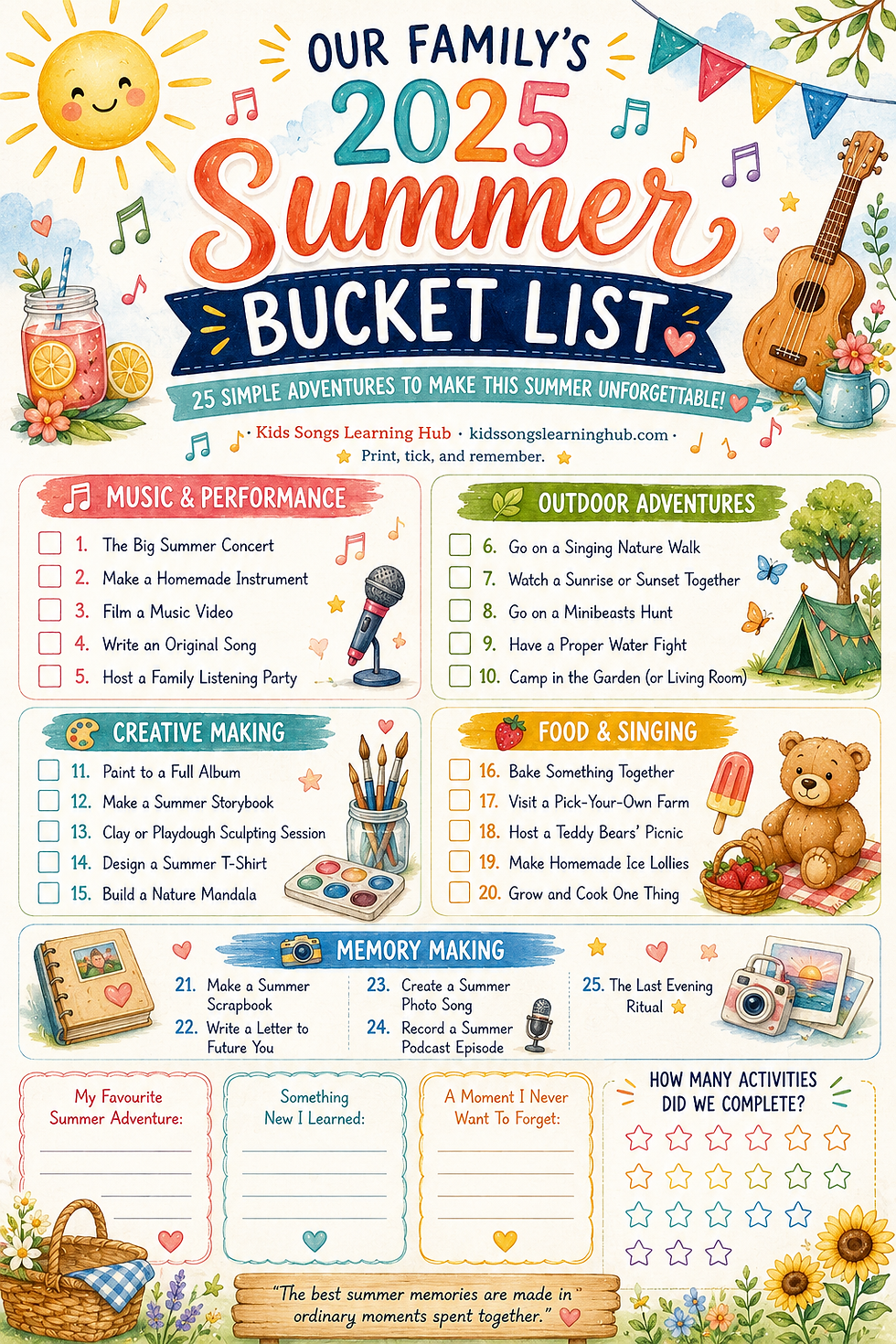
Week-by-Week Summer Planner
You do not need to do five activities every week. This planner is only a gentle suggestion. Move things around depending on weather, energy, budget, family commitments, and what your children are excited about.
Week | Focus | Simple activity ideas |
Week 1 | Music and performance | Start the summer concert idea, choose songs, make a homemade instrument |
Week 2 | Outdoor adventures | Try a singing nature walk, minibeast hunt, or sunset watch |
Week 3 | Creative making | Paint to music, make a summer storybook, or design a t-shirt |
Week 4 | Food and singing | Bake together, make ice lollies, or plan a teddy bears’ picnic |
Week 5 | Memory-making | Start a scrapbook, record a voice note, or make a photo song |
Final evening | Summer reflection | Sing favourite songs and talk about the best memories |
Tips for Making the Summer Bucket List Actually Happen

Let your children help choose
The activities in this article are a starting point. Add your child’s ideas too, even if they are small or unusual. Children are more likely to join in when they feel ownership of the list.
Keep it visible
Stick the printable on the fridge, cupboard, noticeboard, or kitchen wall. Let children tick activities off with a bright pen or sticker.
Do not try to finish everything
A bucket list is not a test. If you complete five activities, that is five lovely memories. If you complete fifteen, wonderful. Leave the rest for another school holiday.
Use rainy-day versions
Camping can become a living room fort. A nature walk can become a window-spotting game. A water play challenge can become bath-time sponge play. British summer weather does not need to ruin the list.
Keep the music simple
You do not need special music skills. Sing familiar songs, make up silly verses, hum while painting, or let your child choose a song for each activity.
Take photos, but also join in
A few photos are lovely, but children also need you in the memory. Put the phone down sometimes and sing, splash, paint, bake, or laugh with them.
Frequently Asked Questions
What ages is this summer bucket list suitable for?
Most activities are best for toddlers, preschoolers, and younger primary-age children, with adult support. Older children can take on more planning, writing, filming, cooking, or leadership. Always adapt activities for your child’s age, abilities, and safety needs.
Do I need to do all 25 activities?
No. Choose the activities that fit your family. The goal is not to complete a perfect list. The goal is to create simple, memorable moments during the summer holidays.
How much does it cost?
Many ideas are free or low-cost. Singing walks, sunset watching, living room camping, voice recordings, homemade songs, and storybooks can cost very little. Some activities may need basic craft supplies, food ingredients, or a local trip.
What if the weather is bad?
Use indoor versions. Build a fort instead of camping outside, paint to music instead of going out, make a rainy-day song, or create a summer scrapbook.
Do I need to be musical?
No. Your child does not need a perfect performance. They need your willingness to join in. Singing together, even badly, can become one of the best parts of the memory.
Is this suitable for nurseries or early years settings?
Many of the ideas can be adapted for nursery, preschool, or childminder settings, especially singing walks, homemade instruments, storybooks, painting to music, and teddy bears’ picnics. Follow your setting’s safeguarding, allergy, outdoor, photo, and risk assessment procedures.
Helpful Related Resources
For travel days, read “Road Trip Songs for Kids: The Ultimate Playlist.”
For shape learning, read “Shape Songs for Kids: Fun Ways to Teach Circles, Squares, and Triangles.”
For toddler language, read “How Music Helps Toddlers Learn Language.”
For free activities, visit the Free Preschool Printables Library.
Final Thoughts
A summer bucket list does not need to be perfect to be meaningful. It can be a crumpled page on the fridge, a few songs, a garden picnic, a homemade instrument, a rainy-day fort, and one sunset you remember for years.
Children often remember the feeling more than the details. They remember that someone sang with them, made space for their ideas, let them tick the list, and turned an ordinary summer day into something worth talking about.
Start with one activity. Choose a song. Tick it off. Let the summer become a story your child can carry into September.
About the Author
Janerine Watson is the founder of Kids Songs Learning Hub, a mother of three, and a BSc Health and Social Care graduate. She creates music-based learning resources, children’s songs, printable activities, and parent-friendly guides that help toddlers and preschoolers learn through rhythm, repetition, movement, routines, and play. Through parenting and her background in health and social care, Janerine shares practical ways families can make everyday learning more playful, memorable, and easier to repeat.
Child Activity and Safety Disclaimer
This article is for educational, parenting, and family activity purposes only. It is not medical, developmental, childcare, nutrition, safety, or professional educational advice. Every child is different, and not every activity will suit every age, ability, need, family situation, or setting.
Always supervise children during outdoor play, water play, cooking, eating, crafting, movement games, small-object play, scissors, glue, clay, paint, gardening, insects, animals, and public outings. Follow sun safety guidance in hot weather, keep children hydrated, and adapt activities for allergies, choking risk, sensory needs, mobility, communication needs, and developmental stage.
If your child has medical needs, allergies, feeding concerns, swallowing difficulties, sensory needs, developmental concerns, or additional needs, speak with a qualified health professional or your child’s support team before trying new activities.


The homemade instruments and funny family song ideas are brilliant—creative, low-cost ways to make memories before school starts. I’ve been using https://veedai.pro
The living-room camping idea and recording a funny family song sound brilliant—simple, low-cost memories the kids will actually remember. I’ve been using https://runwayai.pro
The homemade instruments idea is genius — we made shakers from rice and pasta tubes, and the kids danced for hours. I've been using a free printable chart to track our bucket list, check out https://faceless-ai.net/models/veo3