Summer Learning Activities for Preschoolers: Music, Play and Simple Skills Before School Starts
Updated: Jul 2

Summer should feel like summer. Preschoolers need time to play, rest, move, explore, get messy, sing loudly, and enjoy ordinary family days. But many parents still wonder whether their child will forget some of the skills they practised during nursery, preschool, or reception preparation.
The good news is that summer learning does not need to look like school. For young children, some of the best learning happens through songs, movement, stories, pretend play, outdoor exploring, counting games, crafts, routines, and simple conversations.
Music is one of the easiest ways to keep learning playful. A counting song can practise numbers. An alphabet song can keep letter sounds familiar. A tidy-up song can support routines. A movement song can build listening and coordination. A silly song can help children try new words without feeling tested.
As a mother of three and founder of Kids Songs Learning Hub, I have seen how a short song can turn a tricky moment into a learning moment. This guide gives you simple summer learning activities for preschoolers using music, play, movement, rhythm, and everyday routines.
You will find a flexible summer music plan, alphabet activities, counting games, vocabulary ideas, homemade instrument crafts, movement activities, social skills songs, a printable activity pack, and practical tips for making summer learning feel easy and joyful.
A gentler way to think about the “summer slide”

You may hear people talk about the “summer slide,” meaning that children can lose practice with some skills during long breaks from school or structured learning. For preschoolers, it is better not to panic about this. Young children do not need a summer of worksheets or pressure. They need regular chances to play, talk, sing, count, move, listen, create, and join in with family routines.
Instead of trying to “stop” learning loss completely, aim to keep skills warm. That means giving your child small, repeated opportunities to use the things they have been learning: words, sounds, numbers, colours, shapes, actions, memory, turn-taking, and confidence.
Music can help because it naturally includes repetition, rhythm, movement, listening, memory, and language. It also makes practice feel playful rather than like a lesson.
What summer music activities can support
Skill area | Simple music activity | Why it helps |
Letters and sounds | Alphabet songs and name songs | Keeps letter sounds familiar |
Counting | Counting songs and rhythm beats | Practises number order and one-to-one counting |
Vocabulary | Theme songs about animals, weather, food, or feelings | Adds new words in context |
Movement | Freeze dance, action songs, ribbon dancing | Supports listening, coordination, and body awareness |
Memory | Repeating favourite songs | Helps children remember patterns and sequences |
Social skills | Family band, circle songs, turn-taking games | Practises waiting, copying, sharing, and joining in |
Routines | Morning, tidy-up, bath, and bedtime songs | Makes everyday transitions feel more predictable |
Important note
These activities are for playful summer learning. They do not replace nursery, school, speech and language support, occupational therapy, medical advice, or developmental assessment. If you have concerns about your child’s learning, speech, movement, behaviour, hearing, development, or school readiness, speak with your GP, health visitor, nursery team, teacher, or another qualified professional.

Flexible Summer Music Plan for Preschoolers
This plan is flexible. You can use it across six weeks, repeat it over a longer summer, or choose only the weeks that fit your family. The goal is not to complete everything. The goal is to keep learning light, musical, and easy to repeat.

Week | Focus | Main skills | Simple activities |
Week 1 | Alphabet adventure | Letter sounds, listening, name recognition | Letter sound safari, alphabet freeze dance, name songs |
Week 2 | Counting and rhythm | Counting, patterns, number order | Counting beats, number hopscotch, counting songs |
Week 3 | Vocabulary through themes | New words, categories, describing | Ocean songs, farm songs, weather songs, opposite songs |
Week 4 | Musical crafts | Fine motor skills, creativity, rhythm | Homemade shakers, playdough songs, rhythm cards |
Week 5 | Movement and dance | Coordination, body awareness, listening | Follow-the-leader dance, ribbon dancing, freeze games |
Week 6 | Social music games | Turn-taking, confidence, shared attention | Family band, musical story time, sharing circle songs |
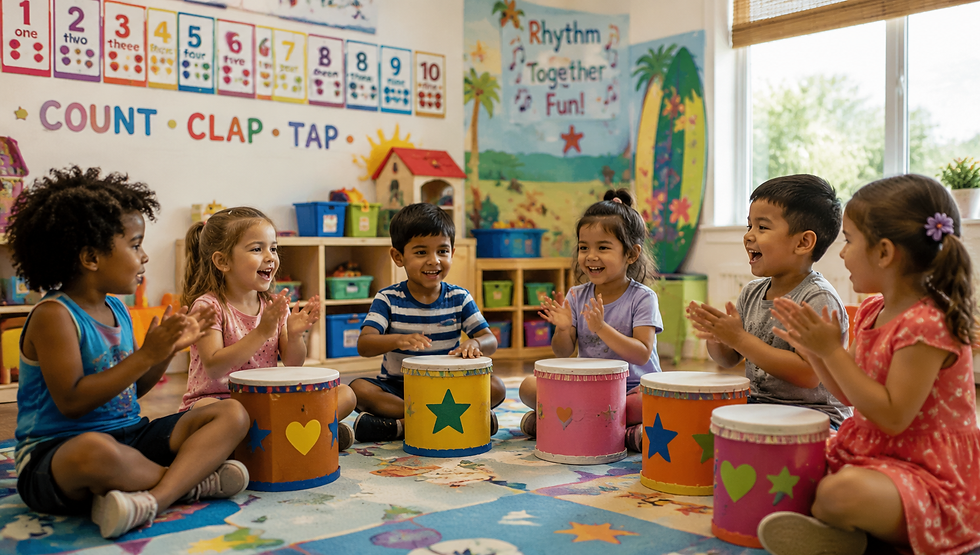
Week 1: Alphabet Adventure Through Song
Goal: Keep letters and sounds familiar through playful songs.
Letter Sound Safari
Go for a short walk or look around the house. Choose one letter sound and find things that begin with that sound. Sing a simple chant such as, “I see a ball, b-b-ball, ball begins with B.” Keep it light and silly.
Alphabet Freeze Dance
Play music and dance. When the music stops, call out a letter. Your child can freeze, make the sound, point to something beginning with that letter, or try shaping the letter with their body.
Name Songs
Use your child’s name and family names in a simple song. For example, “Jenna starts with J, j-j-Jenna.” Personal names make letter sounds more meaningful.
Week 2: Counting and Rhythm
Goal: Practise counting, rhythm, and number order without worksheets.
Counting Beats
Use hands, knees, pots, wooden spoons, or a homemade shaker. Count beats together: “Let’s clap five times.” Then try three, seven, or ten.
Musical Number Hop
Write numbers 1 to 10 on paper or outside with chalk. Play music and ask your child to hop to a number. Keep it safe for the space and your child’s ability.
Counting Song Questions
Sing familiar songs such as Five Little Ducks or Five Little Monkeys. Pause and ask, “How many are left?” It is fine to help. The point is exposure, not testing.
Week 3: Vocabulary Through Themes
Goal: Grow words through songs about real topics.
Theme of the Week
Choose one simple theme: ocean, farm, jungle, weather, feelings, transport, or food. Sing three to five songs connected to that theme during the week.
Create-Your-Own Verse
Take a familiar song and add new words. For example, “Old MacDonald had a zoo” or “The wheels on the tractor go round and round.”
Opposite Songs
Sing about big and small, fast and slow, loud and quiet, happy and sad, high and low. Act each word out with your body.
Week 4: Musical Crafts and Fine Motor Play
Goal: Build hand strength, coordination, and creativity through making.
Homemade Shaker
Fill a sealed container with rice, pasta, or beads, then decorate the outside. Adults should handle small objects and sealing. Use the shaker with counting songs.
Musical Playdough
Roll, squeeze, pat, and shape playdough while singing. Try “roll it round,” “squash it flat,” or “make a snake.”
Rhythm Pattern Cards
Draw simple patterns such as clap-clap-stomp or star-star-heart. Your child can copy the pattern with claps, taps, or stickers.

Week 5: Movement and Dance
Goal: Support listening, coordination, and body awareness.
Follow-the-Leader Dance
Take turns choosing safe movements: clap, jump, wiggle, tiptoe, spin slowly, march, or freeze.
Musical Emotion Moves
Play gentle music and move slowly. Play happy music and bounce. Talk about how the music feels: calm, excited, sleepy, silly, or strong.
Ribbon Dancing
Use ribbons, scarves, or strips of fabric to make circles, waves, zigzags, and rainbows in the air. Keep enough space around your child.
Week 6: Social Music Games
Goal: Practise turn-taking, sharing, waiting, and confidence.
Family Band
Give everyone an instrument, shaker, pot, spoon, clap, or voice part. Practise starting, stopping, playing quietly, and taking turns.
Musical Story Time
Read a familiar book and add sound effects. For example, swish through grass, splash through water, or stomp like an animal.
Passing Song
Pass a soft toy or ball around while singing. When the song stops, the person holding the object chooses the next action, sound, or verse.

Daily Musical Moments: Making Summer Learning Easy

The best summer learning often happens in small moments. You do not need to set up a lesson. Try adding music to routines you already do.
Morning routine songs
Use a simple song for getting dressed, brushing teeth, or packing a bag for a day out. Familiar songs can make routines feel more predictable.
Tidy-up songs
Choose one clean-up song and use it every time. You can also play one upbeat song and tidy until it ends.
Car ride songs
Use car journeys for alphabet songs, counting songs, road trip songs, or silly rhymes. Keep it relaxed and do not turn every drive into a lesson.
Bath-time songs
Sing counting songs with cups, floating toys, or splashes. Always supervise bath time closely.
Bedtime wind-down songs
Use soft, familiar songs to slow the pace before sleep. Keep bedtime music gentle and avoid anything too exciting late in the evening.
🎵 Free Summer Music Learning Printable Pack
To make summer learning even easier, I created a free printable Summer Music Activity Pack for preschoolers.
Inside the printable pack:
Summer song activity chart
Alphabet scavenger hunt tracker
Music & movement challenge cards
DIY instrument activity sheet
Summer rhythm games
Daily music routine checklist
You can print the activities and use them throughout summer break to keep learning playful, screen-light, and stress-free.
How Music Supports Preschool Learning During Summer

Music can support preschool learning because it brings together sound, movement, memory, repetition, and emotion. Children can sing, clap, dance, copy, count, rhyme, listen, and take turns without feeling like they are doing formal work.
Music activities may support:
Listening and attention
Speech and language practice
Rhythm and pattern awareness
Counting and number order
Movement and coordination
Memory and sequencing
Turn-taking and confidence
Routines and transitions
The important word is “may.” Every child is different. Music is a helpful tool, not a guarantee.
Common Parent Challenges
“I cannot sing well.”
Your child does not need perfect singing. Your familiar voice, enthusiasm, and willingness to join in matter more than pitch.
“We do not have instruments.”
You can clap, tap knees, stomp, hum, whisper, or use safe household items. Your body is already an instrument.
“My child will not sit still.”
That is okay. Preschoolers often learn while moving. Try music during walking, tidying, bath time, cooking, dancing, or outdoor play.
“I do not know many children’s songs.”
Start with classics: The Wheels on the Bus, Twinkle Twinkle, Old MacDonald, If You’re Happy and You Know It, Five Little Ducks, Head Shoulders Knees and Toes, and Row Row Row Your Boat.
“My child wants the same song every day.”
Repetition is normal and useful. Keep the favourite song, but change one small part, such as the animal, action, voice, speed, or missing word.
Tracking Progress Without Pressure
You do not need formal tests to know that your child is engaging. Look for small signs such as:
Your child asks for a song again
Your child sings during play
Your child copies an action
Your child remembers part of a rhyme
Your child counts along
Your child makes up a silly verse
Your child uses a song during a routine
Your child notices sounds, rhythms, or words around them
These small signs show that your child is joining in, remembering, practising, and making the music their own.
Helpful Related Resources
For summer family fun, read “Summer Bucket List for Kids: 25 Musical and Creative Activities Before School Starts.”
For road trips, read “Road Trip Songs for Kids: The Ultimate Playlist.”
For alphabet practice, read “Best ABC Songs for Toddlers.”
For movement learning, read “Exercise Songs for Kids.”
For free worksheets and song cards, visit the Free Preschool Printables Library.
More Ways to Use Music for Summer Learning

You do not need expensive apps, formal lessons, or a packed summer timetable to keep preschool learning playful. Start with what you already have at home: your voice, familiar songs, safe movement space, simple craft materials, books, toys, and everyday routines.
Here are simple ways to keep using music through the summer:
Use one song for morning routines
Choose a short getting-ready song for brushing teeth, getting dressed, or packing a bag. Repeating the same song can make the routine feel more predictable.
Use counting songs during play
Count jumps, claps, blocks, toy animals, steps, cups of water, or spoonfuls while singing. Keep it playful and stop before your child feels tested.
Use alphabet songs in small moments
Sing your child’s name, family names, or favourite toy names with letter sounds. For example, “Bella begins with B, b-b-Bella.”
Use movement songs when energy is high
Try freeze dance, follow-the-leader, marching songs, animal walks, ribbon dancing, or action songs. Choose safe movements for the space you are in.
Use gentle songs for transitions
A tidy-up song, bath-time song, leaving-the-park song, or bedtime wind-down song can help children move from one part of the day to the next.
Safety Reminders for Summer Music Activities
Summer music activities should always be adapted for your child’s age, ability, energy level, communication needs, sensory needs, and safety.
For outdoor activities, choose cooler times of day where possible, use shade, hats, suitable clothing, sunscreen, and regular drinks in sunny weather.
For movement activities, make sure there is enough space and avoid slippery floors, sharp corners, stairs, or unsafe jumping areas.
For homemade instruments, adults should handle small objects, sharp tools, glue guns, scissors, and sealing containers. Check instruments before use and avoid anything that could break, spill, or become a choking risk.
For bath-time or water songs, stay close and supervise at all times. Never leave a young child alone near water, even for a moment.
For screen-based music videos, keep use balanced and age-appropriate. Young children learn best when an adult joins in, sings, talks, and plays with them rather than leaving them to watch alone for long periods.
How to Keep It Going After Summer

When September arrives, you do not need to stop using songs. The same musical ideas can support everyday family life during term time too.
Try using songs for:
Morning routines
Getting shoes and coats on
Counting steps to the car or bus stop
Tidying toys
Calming down after nursery or school
Bath time
Bedtime wind-down
Weekend family play
The goal is not to turn every moment into a lesson. The goal is to make learning feel natural, light, and connected to ordinary life. A short song can help children join in, remember what comes next, practise language, move their bodies, and feel more confident..
Final Thoughts

Summer learning activities for preschoolers do not need to feel like school. A short song, a rhythm game, a homemade shaker, a dance break, a counting chant, or a silly rhyme can keep learning active in a joyful way.
Do not worry about doing everything perfectly. Choose one activity this week. Sing a familiar song. Add one movement. Count one rhythm. Make one simple instrument. Let your child laugh, copy, repeat, and lead.
The goal is not to push your preschooler ahead. The goal is to keep curiosity alive, confidence growing, and learning connected to play.
If your child only remembers one thing from the summer, let it be this: learning can happen through joy, rhythm, movement, stories, family routines, and songs sung together.
About the Author
Janerine Watson is the founder of Kids Songs Learning Hub, a mother of three, and a BSc Health and Social Care graduate. She creates music-based learning resources, children’s songs, printable activities, and parent-friendly guides that help toddlers and preschoolers learn through rhythm, repetition, movement, routines, and play. Through parenting and her background in health and social care, Janerine shares practical ways families can make everyday learning more playful, realistic, and easier to repeat.
Educational and Child Development Disclaimer
This article is for educational, parenting, and family learning purposes only. It is not medical, developmental, psychological, therapeutic, speech-language, occupational therapy, or educational assessment advice. Every child learns at their own pace, and not every activity will suit every age, ability, need, temperament, or home situation.
Always supervise children during movement, dancing, outdoor play, water play, bath time, craft activities, small-object play, homemade instruments, scissors, glue, cooking, and public outings. Adapt activities for allergies, choking risk, sensory needs, mobility, communication needs, hearing, developmental stage, and safety.
If you have concerns about your child’s speech, hearing, movement, learning, behaviour, development, school readiness, or emotional wellbeing, please speak with your GP, health visitor, nursery team, teacher, speech and language therapist, occupational therapist, paediatrician, or another qualified professional.


Comments