Free Printable Nursery Rhyme Activities for Toddlers and Preschoolers
Updated: Jun 24
I almost threw away a bundle of printed nursery rhyme activity pages.
It was a Tuesday morning, the kind where nothing goes right before 8 a.m. Olivia, my youngest, had refused breakfast, Lucas was melting down over a missing shoe, and I had fifteen minutes before the school run.
I grabbed a colouring sheet I'd printed the night before, one of Humpty Dumpty sitting on his wall, and slipped it over to Olivia just to give myself two minutes of calm.
What happened next stopped me completely.
She picked up a crayon, started colouring, and began singing. Not perfectly. Not even close to the right words.
But she was singing Humpty Dumpty, a rhyme I hadn't taught her on purpose. The picture in front of her was linked to a song she had picked up along the way. When she saw the egg figure on the page, she said, "He's gonna fall, Mama."
She was predicting story outcomes at age three. From a colouring sheet.
That moment completely changed how I thought about printable nursery rhyme activities. They are not just something to keep kids quiet. They are not filler. When they are thoughtfully designed and intentionally used, free printable nursery rhyme activities for toddlers and preschoolers are genuinely powerful early literacy tools hiding in plain sight.
Through parenting my own children and creating resources for Kids Songs Learning Hub, I have seen how nursery rhyme printables can turn simple songs into hands-on learning moments. A colouring page, sequencing card, puppet, or matching game can help children connect what they hear in a rhyme with what they see, say, colour, count, and act out.
This article shares how to use free printable nursery rhyme activities for toddlers and preschoolers in a way that supports early language, listening, fine motor skills, storytelling, and playful learning at home.

Why Nursery Rhyme Printables Support Early Learning
Quick note before we start into the printables themselves, because I think it matters for how you approach this whole topic.
Nursery rhymes are often dismissed as simple entertainment. Cute little songs for tiny children before the "real" learning begins. That dismissal could not be more wrong, and the research backs me up on this.
Nursery rhymes help children hear rhythm, rhyme, repetition, and story structure. When children sing familiar rhymes and then colour, match, sequence, or act them out with a printable, they are using more than one sense at a time. They are listening, looking, moving, speaking, and remembering.
This matters because early literacy begins long before formal reading. Children first learn to notice sounds, predict what comes next, remember repeated phrases, and connect words with meaning. Nursery rhyme printables can support those early skills in a gentle, playful way.
Parent note: You do not need to turn printables into worksheets or tests. The best learning happens when you sing first, talk together, let your child try, and keep the activity relaxed.
When a toddler hears that "Jill" rhymes with "hill" and "Jack" rhymes with "back," they are not just enjoying a story. They are training their auditory system to detect phonemes, the smallest units of sound in language. This is the same skill that reading specialists spend significant time developing in struggling readers. Nursery rhymes develop it naturally, joyfully, and for free.
Discover how rhythm and songs strengthen vocabulary and speech development in our article “Why Music is the Secret to Faster Language Development in Preschoolers.”
In addition to teaching sounds, baby rhymes help kids learn new words, understand stories, remember things, put things in the right order, and understand other cultures. They've been passed down from generation to generation because they work. When you pair them with well-thought-out printable tasks, you add to the list of benefits visual processing, fine motor development, and hands-on learning.
What Makes a Good Nursery Rhyme Printable

A good printable should help the child do something meaningful with the rhyme. For example, Humpty Dumpty printables can help children practise story order, Five Little Ducks printables can support counting, and Incy Wincy Spider activities can support actions, sequencing, and fine motor skills.
The printable does not need to be complicated. For toddlers, simple is usually better. Large pictures, clear lines, familiar characters, and one main task per page are often more effective than busy pages with too many instructions.
Not all printables are created equal. I have downloaded hundreds of them over the years, and I have learned to recognise quickly which ones will actually support learning and which ones are just pretty pictures with no educational substance behind them.
Here is what I look for in high-quality nursery rhyme printables for toddlers and preschoolers:
Age-appropriate design. Toddlers need large images, thick lines for coloring, and minimal text. Preschoolers can handle slightly more detail, simple words or letters incorporated into the design, and more complex activities like sequencing or matching.
Connection to the actual rhyme content. The best printables reinforce specific elements of the rhyme rather than just using a character as decoration. A printable featuring Jack and Jill should ideally involve sequencing (what happened first, next, last) or vocabulary from the rhyme itself.
Multi-skill integration. The printables I reach for most often are the ones that develop multiple skills simultaneously. A single well-designed page might develop fine motor skills through colouring, vocabulary through labelling, phonemic awareness through rhyme identification, and narrative comprehension through sequencing, all at once.
Open-ended elements. Activities that have a single right answer exhaust their usefulness quickly. Printables that include drawing prompts, "what would you do?" questions, or creative extension activities can be used multiple times without becoming repetitive.
Clean, uncluttered design. Too many elements on a single page overwhelm young children and make it hard for them to focus on any one learning objective. The best printables are visually clean and organised.
Best Types of Nursery Rhyme Printable Activities
To make this article easier to use, add a free Nursery Rhyme Activity Pack for toddlers and preschoolers. This printable gives families simple pages they can use alongside familiar songs such as Humpty Dumpty, The Wheels on the Bus, Incy Wincy Spider, Five Little Ducks, and more.
🎵 Free Nursery Rhyme Printable Pack
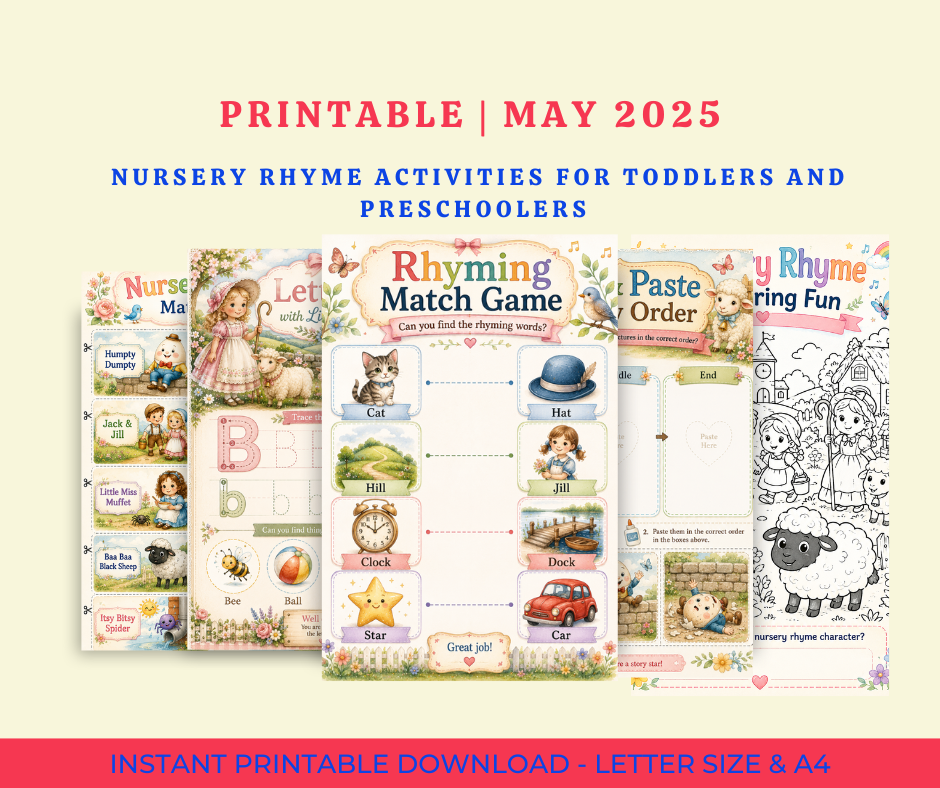
Want ready-to-use nursery rhyme activities for toddlers and preschoolers?
Nursery rhyme colouring pages
✓ Rhyme sequencing cards
✓ Count and sing activity pages
✓ Rhyme matching games
✓ Simple tracing sheets
✓ Nursery rhyme puppet cards
✓ Sing-along activity pages
You can download it from the Free Preschool Printables Library and use it during quiet time, preschool learning, story time, or music time.
Helpful Related Resources
If your child enjoys nursery rhymes, visit our Nursery Rhymes page for videos, lyrics, and sing-along learning ideas.
For more song-based learning, read “Best Nursery Rhymes for Toddlers: 20 Songs That Support Early Learning.”
For speech and language support, read “Fun Songs to Help Toddlers Talk: Boost Speech and Language Development.”
You can also visit the Free Preschool Printables Library for nursery rhyme pages, song trackers, toddler activities, and preschool learning printables.
Colouring and Illustration Pages
These are the entry points for most families and the right starting points for toddlers. A nursery rhyme colouring page does more than just develop fine motor skills through the act of colouring. When paired with singing the rhyme aloud, it creates a multimodal learning experience that connects auditory and visual processing in powerful ways.
The most effective approach is to sing the rhyme together before your child starts colouring, then sing it again while they colour. This repetition with a physical activity anchoring the experience dramatically improves retention of both the vocabulary and the phonological patterns in the rhyme. You may also enjoy our guide “How Animal Songs Build Vocabulary in Preschoolers” for more music-based language activities.

Where to Find Quality Free Coloring Pages:
Super Colouring (supercoloring.com) offers an extensive library of nursery rhyme characters with both simple outlines for toddlers and more detailed versions for preschoolers. The site is free and does not require an account.
First Palette (firstpalette.com) provides nursery rhyme colouring pages alongside suggested discussion questions and extension activities, making them unusually educational for a free resource.
Education.com offers nursery rhyme colouring pages as part of their free tier, and many include basic literacy elements like the rhyme text printed below the image.
How I Use These at Home:
Rather than just handing Olivia a colouring page, I sit with her, and we make choices together. "What color should Humpty Dumpty's jacket be? What do you think Little Bo Peep's sheep look like?" These conversations build descriptive vocabulary and give children agency in the learning process, which increases engagement and ownership.
Sequencing Cards and Story Order Activities

Sequencing printables are some of the best nursery rhyme activities for kids' growth. They ask kids to put the pictures from a baby rhyme in the right order (beginning, middle, end). This helps them understand stories better, think logically, and realise that stories have a structure.
These skills can be used right away to understand what you read. There is a big difference in how well kids understand what they read, depending on whether they know that stories have a starting, a problem, and an answer.
For toddlers, start with two-card sequences. What happened first? What happened after? For preschoolers, three and four-card sequences are appropriate, and some children are ready for five or six-card sequences that capture more nuanced story detail. Read “How to Use Storytelling Toys to Teach Your Child Their First Nursery Rhymes” for more hands-on storytelling ideas.
Nursery Rhymes That Work Particularly Well for Sequencing:
Humpty Dumpty (sat on wall, fell down, couldn't be put together again) provides a clear three-part sequence that even young toddlers can grasp.
Jack and Jill (went up the hill, Jack fell, tumbled down) offer both sequential events and cause-and-effect thinking opportunities.
Little Miss Muffet (sat down, spider appeared, she ran away) includes an element of emotional response that opens rich discussion opportunities.
The Itsy Bitsy Spider (went up, rain came down, sun came out, went up again) teaches the concept of a circular narrative, which is more sophisticated and appropriate for older preschoolers.
Where to Find Free Sequencing Printables:
Teachers Pay Teachers (teacherspayteachers.com) has numerous free nursery rhyme sequencing activities uploaded by educators. Search "nursery rhyme sequencing free" and filter by price to access free options.
Totschooling (totschooling.net) specializes in toddler and preschool printables and offers beautifully designed nursery rhyme sequencing cards that are both educationally sound and visually appealing.
The Measured Mom (themeasuredmom.com) offers free nursery rhyme sequencing printables alongside detailed instructions for how to use them effectively, which I deeply appreciate as someone who wants to use activities intentionally rather than just for busy work.
Rhyme and Match Activities

These printables present images and ask children to identify which ones rhyme, or to match rhyming pairs. They are targeting phonemic awareness directly, specifically the ability to hear rhyme, which, as I mentioned earlier, is one of the strongest predictors of future reading success.
The key to making these activities effective is to say the words aloud while doing them. Never let a child complete a rhyming activity silently. The entire purpose is to develop auditory discrimination, and that only happens when the sounds are being processed through the auditory system.
"Does CAT rhyme with HAT? Let's say them together. Cat. Hat. They sound the same at the end! They rhyme!"
This verbalization is not optional. It is the learning.
Variations That Work Well:
Picture-to-picture rhyme matching works for toddlers who are not yet reading. They see a picture of a cat and must find its rhyming partner from several options.
Word-to-picture matching is appropriate for preschoolers who are beginning to recognize letters and simple words. They see the written word "cat" and must find a picture of something that rhymes with it.
Rhyming sort activities ask children to sort pictures into groups that rhyme together, which requires a higher level of phonological processing than simple matching.
Where to Find Free Rhyming Printables:
Playdough to Plato (playdoughtoplato.com) offers free nursery rhyme rhyming activities that are consistently high-quality and thoughtfully designed. Their rhyming cards are among my personal favourites.
Mrs. Wills Kindergarten (mrswillskindergarten.com) provides free nursery rhyme phonemic awareness printables that target rhyming specifically with clear, child-friendly illustrations.
Kindergarten Worksheets and Games (kindergartenworksheetsandgames.com) has an extensive free library of rhyming activities organised by nursery rhyme, making it easy to find activities that match the specific rhyme you are working with.
Beginning Sound and Letter Activities

For preschoolers who are ready for more explicit phonics connection, nursery rhyme printables that highlight beginning sounds and letter recognition are incredibly valuable. These activities take the phonemic awareness developed through rhyming and bridge it to the alphabetic principle, which is the understanding that letters represent sounds.
A well-designed printable might show the Itsy Bitsy Spider at the top of the page and ask children to circle all the pictures that start with the same sound as "spider." Or it might feature Jack and Jill and focus specifically on the letter J, showing the character alongside other pictures and words that begin with J.
The familiar, beloved context of nursery rhymes makes phonics instruction feel less abstract and more connected to stories and characters children already love. This emotional connection matters enormously for engagement and memory.
How I Introduced Letter Activities Through Nursery Rhymes:
When Emma was four and beginning to connect letters with sounds, I created a simple activity around Little Bo Peep. We talked about the /b/ sound in "Bo" and "Baa" (from "Baa Baa Black Sheep," which we learned the same week). We hunted through magazines for pictures that started with B and glued them onto a Bo Peep printable. She still remembers that the letter B "says /b/ like Bo Peep" years later.
Where to Find Free Beginning Sound Printables:
Confessions of a Homeschooler (confessionsofahomeschooler.com) offers nursery rhyme unit studies that include letter-focused printables alongside the broader activities.
123 Homeschool 4 Me (123homeschool4me.com) has free nursery rhyme printable packs that often include letter recognition and beginning sound activities.
Itsy Bitsy Learners (itsybitsylearners.com) specializes in nursery rhyme-based learning and offers free printables that systematically connect rhymes to letter sounds in developmentally appropriate ways.
Counting and Number Activities

Nursery rhymes are surprisingly rich with mathematical content, and printables that highlight this mathematical layer add significant learning value. Counting activities, number recognition, one-to-one correspondence, and even basic addition and subtraction concepts can all be explored through nursery rhyme printables.
"One, Two, Buckle My Shoe" is an obvious choice for counting activities. "Five Little Ducks" and "Five Green and Speckled Frogs" provide natural contexts for counting backward and exploring subtraction concepts. "Ten in the Bed" is perfect for counting from ten to one. "Baa Baa Black Sheep" introduces the concept of three groups (one for the master, one for the dame, one for the little boy) in a way that young children find naturally interesting. Explore “The Ultimate List of Songs to Teach Kids Colours and Numbers” for more playful early math learning ideas.
Types of Math Printables That Work Well:
Counting and colouring activities where children count nursery rhyme characters and colour the corresponding number.
Number-matching activities where children draw a line from a nursery rhyme character to the correct number.
Simple addition scenes where the printable shows characters from a rhyme and asks, "How many altogether?"
Patterns activities using nursery rhyme characters to create and extend simple ABAB patterns.
Where to Find Free Math-Based Nursery Rhyme Printables:
Mama's Learning Corner (mamaslearningcorner.com) offers free nursery rhyme math printables that are clearly organized and educationally strong.
Royal Baloo (royalbaloo.com) specializes in playful learning printables and has nursery rhyme counting activities that are both cute and substantive.
Living Life and Learning (livinglifeandlearning.com) provides free nursery rhyme printable packs that include math activities alongside literacy components.
Fine Motor and Tracing Activities
Fine motor development is a critical component of preschool readiness, and nursery rhyme printables can support it beautifully. Tracing activities, dot-to-dot pages, cutting activities, and lacing card templates all develop the hand strength, pencil grip, and hand-eye coordination that children will need for writing.
The nursery rhyme connection makes these activities more engaging than generic fine motor worksheets. A child is not just tracing a line. They are helping Jack walk up the hill. They are not just connecting dots. They are revealing Humpty Dumpty sitting on his wall. The narrative context provides motivation and meaning that increases perseverance through the challenge of fine motor work.
Tracing Activities That Develop Multiple Skills:
Letter tracing pages featuring the first letter of a nursery rhyme character's name (B for Bo Peep, J for Jack, H for Humpty) connect fine motor practice to letter recognition.
Path tracing activities where children trace a winding path to help a character reach their destination develop pencil control while reinforcing the rhyme's narrative.
Shape tracing hidden within nursery rhyme scenes develop both geometric knowledge and fine motor control simultaneously.
Where to Find Free Fine Motor Nursery Rhyme Printables:
PreK Pages (prekpages.com) offers free nursery rhyme tracing and fine motor printables with excellent design quality.
Fun with Mama (funwithmama.com) provides free printable packs for popular nursery rhymes that typically include fine motor components alongside literacy activities.
Gift of Curiosity (giftofcuriosity.com) has thoughtfully designed nursery rhyme fine motor printables with clear instructions for how to use them effectively.
My Favorite Free Printable Packs by Nursery Rhyme
Here is a quick reference guide to the best free printable resources organized by specific nursery rhyme:

Nursery Rhyme | Best Free Resource | Skills Covered | Age Range | Notes |
Humpty Dumpty | Sequencing, coloring, vocabulary | 2 to 5 years | Excellent sequencing cards | |
Jack and Jill | The Measured Mom | Sequencing, beginning sounds, math | 3 to 6 years | Strong literacy focus |
Little Bo Peep | Teachers Pay Teachers (free) | Counting, letter B, coloring | 2 to 5 years | Search for free versions |
Itsy Bitsy Spider | Playdough to Plato | Rhyming, fine motor, sequencing | 2 to 5 years | Consistently high quality |
Baa Baa Black Sheep | 123 Homeschool 4 Me | Counting, letter recognition, coloring | 2 to 5 years | Good math integration |
Little Miss Muffet | Itsy Bitsy Learners | Vocabulary, sequencing, emotions | 3 to 6 years | Great for discussion |
One Two Buckle My Shoe | Mama's Learning Corner | Counting, number recognition, tracing | 2 to 5 years | Strong math focus |
Five Little Ducks | Living Life and Learning | Counting backward, subtraction | 3 to 6 years | Good for early math |
Hickory Dickory Dock | Gift of Curiosity | Telling time, sequencing, rhyming | 3 to 6 years | Unique time-telling angle |
Mary Had a Little Lamb | First Palette | Coloring, vocabulary, creative extension | 2 to 5 years | Good for toddlers |
How to Use One Printable in Three Simple Steps
1. Sing the rhyme first. Let your child hear the words, rhythm, and story before the printable begins.
2. Do the activity together. Colour, match, trace, count, cut, or act out the rhyme while talking about what is happening.
3. Sing the rhyme again. Repeating the song after the activity helps children connect the printable back to the words and story.
This simple sing, do, sing-again rhythm makes printable learning feel natural instead of formal.
Creating Your Own Simple Nursery Rhyme Printables

Sometimes the perfect printable does not exist, and the best option is to make your own. I know that sounds intimidating, but creating basic nursery rhyme activity pages does not require design skills or special software.
The simplest approach is to print a colouring page of a nursery rhyme character and add your own handwritten activity elements. Write the first letter of the character's name at the bottom and ask your child to trace it. Write two words from the rhyme and ask your child to circle the one that rhymes with a word you say aloud. Draw a simple number line and ask them to count the characters and circle the correct number.
Canva (canva.com) offers free templates that make creating simple printable pages genuinely accessible even for non-designers. You can add nursery rhyme images (many are in the public domain and freely available), text, and simple activity elements without any graphic design experience.
Microsoft Word or Google Docs can also work for creating simple printable pages with text-based activities if images feel too complicated.
The best thing about making your own is that you can tailor every element to your specific child's current developmental level and areas of growth. That personalisation is something no commercially produced printable can replicate.
Building a Nursery Rhyme Printable Library at Home

One of the most practical things I have done for our home learning environment is build a simple nursery rhyme printable library. It takes about two hours to set up initially and saves enormous amounts of time and decision-making energy going forward.
Here is my system:
Step one is to choose ten to fifteen nursery rhymes to focus on for a season. Do not try to cover everything. Deep familiarity with a smaller number of rhymes is more valuable than surface exposure to many.
Step two is to find and print at least three to five different activity types for each rhyme: a coloring page, a sequencing activity, a rhyming or phonics activity, a math activity, and a fine motor activity. Print multiple copies of your favourites.
Step three is to organise everything into labelled folders or a binder with divider tabs. When you want an activity for the day, you can reach into the appropriate folder without any preparation or searching.
Step four is to laminate the activities you plan to use repeatedly and store them with dry-erase markers.
Step five is to refresh the library seasonally, retiring rhymes your child has thoroughly mastered and introducing new ones to keep things fresh.
This system has been one of the most practically useful things I have implemented in our home, and I recommend it wholeheartedly to any parent who wants to be intentional about early literacy without spending enormous amounts of time preparing for it day by day.
Looking for more screen-free preschool learning ideas? Read “20 Best Summer Activities for Toddlers That Don’t Involve a Screen.”
The Bigger Picture of Nursery Rhyme Learning

I want to close with something that I think gets lost in the practical details of printable recommendations and activity ideas.
Nursery rhymes have been shared between adults and children for centuries. Long before literacy was universal, long before educational research existed, caregivers passed these rhymes down because they worked. They held children's attention. They were easy to remember. They made language feel like something joyful and musical rather than something to be studied and mastered.
The free printable nursery rhyme activities we have access to now are just new ways to use this beautiful old practice. Printables work best when you use them to connect, not to teach, as ways to connect with each other: to sing together, laugh at the silly pictures, wonder what will happen next, and ask and answer questions.
When Olivia colored that Humpty Dumpty page and predicted that he was going to fall, she was not just demonstrating narrative comprehension. She was doing what humans have always done with stories: making meaning, feeling something, connecting an experience in front of her to knowledge she already carried inside.
That is what nursery rhymes do. That is what they have always done.
The printables just give little hands something to do while their hearts and minds are busy falling in love with language.
About the Author
Janerine Watson is the founder of Kids Songs Learning Hub, a mother of three, and a BSc Health and Social Care graduate. She creates music-based learning resources, children’s songs, printable activities, and parent-friendly guides that help toddlers and preschoolers learn through rhythm, repetition, movement, language, and play. Through parenting and creating early learning content, Janerine has seen how nursery rhymes and simple printables can support vocabulary, listening, memory, fine motor skills, confidence, and joyful family connection.
Educational Disclaimer
This article is for educational and family learning purposes only. Nursery rhyme printables, songs, colouring pages, sequencing activities, and matching games can support early language, listening, memory, fine motor skills, and playful learning, but every child develops at their own pace. Always supervise children when using scissors, small pieces, craft materials, laminating sheets, dry-erase markers, or printed activity cards. If you have concerns about your child’s speech, hearing, development, or learning, speak with a qualified health visitor, pediatrician, speech and language therapist, or early years professional.


Comments