25 Best Bird Songs for Kids That Inspire Singing, Learning & Nature Play
Updated: Jul 12

One spring morning, my youngest child stopped halfway across the garden, pointed excitedly towards a hedge, and whispered, "Listen... that bird is talking to me."
Of course, the little sparrow wasn't calling his name, but in that moment it didn't matter. He wasn't simply hearing a bird. He was listening with curiosity.
Moments like that remind me why I love using music to help children learn. A simple song can encourage a child to notice the world around them in a completely new way. Suddenly birds become more than tiny shapes flying overhead. They become robins, blackbirds, owls, ducks, woodpeckers, sparrows, and bluebirds, each with their own sounds, movements, and stories.

As the founder of Kids Songs Learning Hub and a mother of three, I've discovered that bird songs are some of the easiest ways to introduce children to both music and nature. Whether we're singing during a walk through the park, watching birds from the kitchen window, or pretending to flap around the living room, these little musical moments often become the memories children remember long after the song has finished.
The wonderful thing about bird songs is that they encourage children to slow down.
Instead of rushing from one activity to another, they begin listening.
They notice different sounds.
They start asking questions.
They become curious about the natural world.
That curiosity is where so much learning begins.
In this guide you'll discover 25 wonderful bird songs for kids, along with simple ideas for turning each song into a playful learning experience. You'll also find easy nature activities, bird-watching ideas, movement games, and a free printable activity pack designed to help children continue learning after the music stops.
Whether you're a parent, grandparent, nursery practitioner, preschool teacher, homeschool family, or simply someone who loves sharing music with children, I hope these ideas inspire many happy moments outdoors and many cheerful songs indoors.
Why Bird Songs Are Wonderful Learning Tools

Bird songs are much more than fun tunes about feathered friends.
For young children, they naturally combine music, movement, language, listening, observation, imagination, and outdoor exploration.
Children are naturally fascinated by birds because they move in interesting ways.
Some hop.
Some glide.
Some flap.
Some swoop.
Some waddle.
Some sing loudly while others make quiet calls that encourage children to stop and listen carefully.
That simple act of listening is an important early learning skill.
When children hear different bird sounds, they begin noticing differences between loud and quiet sounds, high and low pitches, fast and slow rhythms, and repeated patterns. They are developing careful listening without even realising they're practising.
Music adds another layer.
Songs help children remember names, actions, and ideas through repetition. Singing about robins, ducks, owls, sparrows, or woodpeckers makes those birds easier to recognise when children later spot them in a garden or local park.
According to the National Association for the Education of Young Children (NAEYC), music, movement, and playful language experiences can support young children's communication and learning through enjoyable everyday interactions.
Nature experiences also give children opportunities to observe living things respectfully and ask questions about the world around them.
Bird songs naturally encourage conversations such as:
"Why is that bird singing?"
"Where do birds sleep?"
"Why does that duck have webbed feet?"
"Can birds hear each other?"
Those conversations build vocabulary, curiosity, confidence, and family connection.
Most importantly, bird songs remind children that learning does not only happen indoors.
It happens in gardens.
In parks.
On family walks.
Outside school.
Looking through the window.
Listening before breakfast.
Watching birds build nests in spring.
These everyday moments often become the most meaningful lessons.
What Children Learn Through Bird Songs
Bird songs can gently support many early learning skills, including:
listening carefully
recognising different sounds
building vocabulary
learning animal names
movement and coordination
counting
memory
rhythm
observation
storytelling
imaginative play
appreciation for wildlife
confidence speaking about nature
Rather than treating birds as another lesson to memorise, children begin seeing them as part of everyday life.
That connection is something worksheets alone cannot easily create.
How to Use Bird Songs by Age
Toddlers (2–3 years)
Keep songs short, repetitive, and full of actions.
Flap your arms together.
Hop like little birds.
Pretend to peck for seeds.
Tweet together.
Smile.
Laugh.
Repeat.
At this stage your child may not sing every word, and that's perfectly normal. Copying sounds, movements, and simple actions is already valuable learning.
Keep sessions playful and stop before your child loses interest.
Preschoolers (3–5 years)
Preschool children love pretending.
Bird songs become even more enjoyable when children can act out each bird.
Ask simple questions during songs such as:
"Can you fly like an owl?"
"Can you waddle like a duck?"
"Which bird is the loudest?"
"Can you find something that looks like a nest?"
Songs can also become wonderful opportunities for drawing birds, making nests from craft materials, or watching birds from the window afterwards.
Early Learners (5–7 years)
Older children are ready for a little more exploration.
After singing together you might:
identify birds in books
compare different bird calls
draw favourite birds
keep a bird-watching journal
count birds in the garden
match birds to their habitats
learn simple facts about migration
discuss how birds help nature
These activities naturally combine music, science, literacy, observation, and creativity without feeling like formal lessons.
Above all, remember that children do not need to identify every bird correctly.
The goal is not to create young ornithologists overnight.
The goal is to encourage curiosity, careful listening, joyful singing, and a lifelong appreciation for the natural world.
Our Nest of Songs: The 25 Best Bird Songs for Kids

1. Five Little Ducks
Best for: Counting, sequencing, movement, and early maths
Few children's songs have remained as popular as Five Little Ducks, and it's easy to see why. The simple counting pattern, repeated phrases, and gentle story make it a favourite for toddlers and preschoolers alike.
What I love most about this song is that children rarely realise they're practising maths while they're singing. They're counting forwards, counting backwards, following a sequence, and beginning to understand the idea of "one less" in a playful, pressure-free way.
Learning skills this song supports
Counting backwards from five
Number recognition
Listening skills
Memory
Sequencing
Early subtraction concepts
Gross motor movement
Try this activity
Place five toy ducks, paper ducks, or yellow building blocks on the floor.
As each duck "swims away," move one duck aside and ask:
How many ducks are left?
Can you count them together?
Which duck swam away first?
Can we bring them all back?
Children enjoy physically moving the ducks, which helps connect number words with real objects.
Parent tip
Take this learning outside.
If you visit a pond, count real ducks together instead of rushing past them. Even spotting two or three birds becomes a wonderful opportunity to practise counting while enjoying nature.
2. Little Robin Redbreast

Best for: Listening, observation, and seasonal learning
This traditional rhyme introduces children to one of Britain's best-known garden birds.
Rather than focusing only on singing, use the rhyme to encourage children to notice robins when you're outdoors. Their bright red chest makes them one of the easiest birds for young children to recognise.
Songs become far more meaningful when children later spot the bird they've been singing about.
Learning skills this song supports
Bird identification
Listening
Seasonal awareness
Observation
Vocabulary
Nature appreciation
Try this activity
Look at photographs of robins before going outside.
Can your child find:
a red breast?
a small beak?
tiny feet?
feathers?
wings?
After your walk, ask your child to draw the robin from memory.
Don't worry about making the drawing perfect. The goal is careful observation rather than artistic accuracy.
Parent tip
If you have a garden, encourage quiet bird watching for just five minutes.
Children are often amazed by how many different birds they notice once they stop talking and simply listen.
3. Six Little Birds
Best for: Counting, comparing, and imaginative play
Songs about groups of birds naturally encourage children to compare numbers, colours, sizes, and movements.
Whether you're singing about six little birds on a fence or six birds in a tree, children enjoy imagining where each bird might fly next.
Learning skills this song supports
Counting
Comparing quantities
Colour recognition
Describing words
Imaginative storytelling
Listening
Try this activity
Cut out six simple bird shapes from coloured paper.
Invite your child to:
sort them by colour
line them up from left to right
count them slowly
hide one bird and ask how many remain
invent names for each bird
This simple activity combines music with early maths and language development.
Parent tip
Older children can make up their own verses by changing where the birds are sitting.
For example:
Six little birds in a tree.
Six little birds on a fence.
Six little birds by the river.
Creating new verses encourages creativity while keeping the familiar counting pattern.
4. The Owl Song
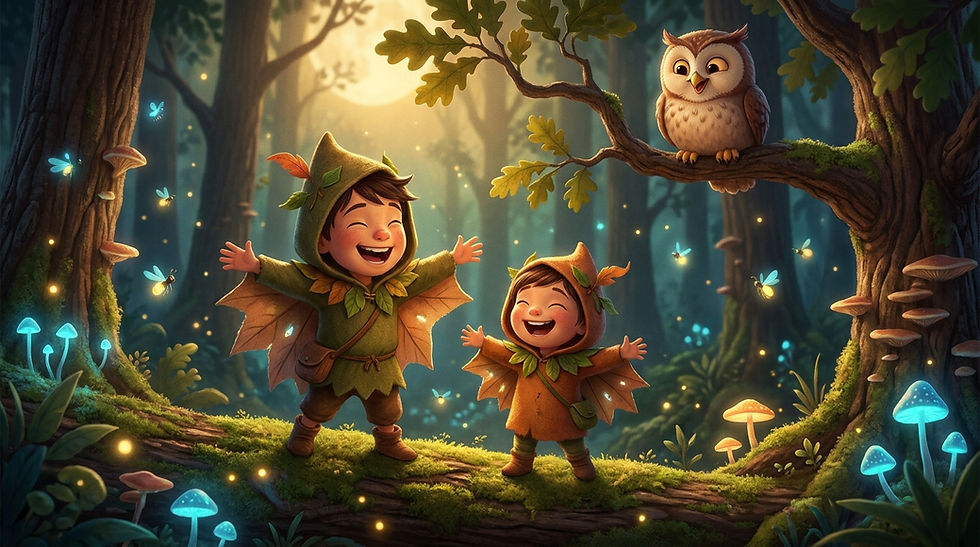
Best for: Night-time animals, listening, and imaginative movement
Owls capture children's imagination because most of us hear them long before we ever see them.
This makes owl songs perfect for encouraging careful listening.
Instead of focusing on facts, invite children to imagine how quietly an owl flies through the night.
Learning skills this song supports
Listening carefully
Animal habitats
Night and day
Quiet movement
Imaginative play
Vocabulary
Try this activity
Dim the lights slightly and pretend your living room has become a woodland at night.
Invite your child to:
flap slowly like an owl
turn their head carefully
spread wide wings
glide quietly around the room
make a gentle "hoot"
This calm movement activity works particularly well before bedtime.
Parent tip
If you hear an owl outdoors one evening, pause for a moment and simply listen together.
Those quiet shared moments often become children's favourite memories of nature.
Learning Through Bird Songs
One of the biggest benefits of bird songs is that they encourage children to slow down and notice the world around them.
Instead of simply singing and moving on, take a few extra minutes to ask simple questions:
Which bird was your favourite?
Which bird was the loudest?
Which bird flew the highest?
Which bird would you like to see one day?
Which bird would you draw?
Questions like these encourage children to think, observe, communicate, and use new vocabulary naturally.
Remember, the goal isn't to memorise facts about birds.
It's to help children enjoy learning through music, movement, conversation, and time spent together.
5. A Little Bird Once Came to My Window
Best for: Kindness, observation, and gentle singing
This traditional song has been enjoyed by generations because it encourages children to notice birds in everyday places. Its calm pace makes it especially suitable for quieter moments, such as story time or winding down after outdoor play.
Learning skills this song supports
Observation
Listening
Gentle movement
Vocabulary
Caring for wildlife
Try this activity
Sit near a window with your child for five minutes.
Ask:
Can you hear any birds?
What colour are they?
Are they flying or hopping?
What do you think they're looking for?
Even if no birds appear, listening quietly together helps children practise patience and observation.
6. Birdie Birdie in the Sky
Best for: Gross motor skills and imagination
Children naturally love pretending to fly, and this simple action song gives them plenty of opportunities to stretch, flap, glide, hop, and balance.
Learning skills this song supports
Gross motor development
Balance
Body awareness
Following instructions
Imaginative play
Try this activity
Create an indoor "bird adventure."
Invite children to:
fly over cushions
hop around "trees"
land on coloured circles
stretch their wings
build a pretend nest
Simple movement keeps children engaged while giving them opportunities to practise coordination.
7. Three Little Birds
Best for: Positive feelings and relaxed family singing
Many families enjoy this well-known song because of its reassuring message and gentle rhythm.
Rather than focusing on performance, simply enjoy singing together and talking about how birds often continue singing, even after rainy weather has passed.
Learning skills this song supports
Listening
Family bonding
Emotional vocabulary
Positive routines
Music appreciation
Parent tip
After singing, ask your child:
"What makes you feel happy today?"
This encourages conversation while keeping the focus on family connection rather than perfect singing.
8. Hush Little Baby
Best for: Bird vocabulary and bedtime routines
Although this lullaby isn't entirely about birds, one of its best-known verses introduces a little mockingbird.
This creates a lovely opportunity to talk about different kinds of birds while helping children settle before sleep.
Learning skills this song supports
Listening
Vocabulary
Bedtime routines
Calm breathing
Family connection
Try this activity
Look at pictures of different birds before bedtime.
Can your child spot:
a robin
an owl
a duck
a sparrow
a blackbird
Keep the conversation gentle and relaxed rather than turning it into a quiz.
9. Little Bird, Little Bird
Best for: Colour recognition and movement
This cheerful action song invites children to flap, hop, fly, and notice different colours.
Learning skills this song supports
Colour recognition
Following directions
Gross motor skills
Listening
Vocabulary
Try this activity
Give children coloured scarves.
When a colour is mentioned, wave the matching scarf while pretending to fly.
You can also hide coloured feathers around the room for children to find.
10. Bird Watching Song (Original Family Song)

Sometimes the simplest songs become children's favourites.
Instead of relying only on published songs, create your own short bird-watching song while exploring outdoors.
For example:
🎵
"Let's look up high...Who's flying by?Can we spotA bird today?"
Simple original songs like this belong to your family and can easily become part of your everyday walks.
Learning skills this song supports
Creativity
Observation
Listening
Language development
Family connection
Parent tip
Children often love hearing songs that include their own names.
Try changing a line to:
"Can Emma find a robin?"
or
"Can Noah hear an owl?"
Personalising songs keeps children engaged and makes the experience feel special.
11. Two Little Blackbirds
Best for: Listening, opposites, and finger play
This classic finger play encourages children to use both hands while learning simple positional words like "near" and "far."
Learning skills supported
Fine motor skills
Listening
Positional language
Memory
Turn-taking
Try this activity
Draw two little birds on your fingertips or use finger puppets.
Move one hand close and one far away while saying the opposite words together.
12. Robin in the Rain
Best for: Weather learning and observation
Robins can often be spotted throughout the year, making them a wonderful bird for discussing changing weather and seasons.
Learning skills supported
Weather vocabulary
Observation
Seasonal awareness
Descriptive language
Try this activity
After rainfall, look outside together.
Ask:
Can you spot any birds?
Where are they looking for food?
What colour are they?
13. Little Bird Fly Away

Best for: Gross motor movement
Children love pretending to fly.
This simple action song encourages stretching, balancing and imaginative play.
Learning skills supported
Coordination
Balance
Following instructions
Body awareness
Try this activity
Place hoops or cushions around the room as pretend nests.
Children fly between them before returning "home."
14. The Cuckoo Song
Best for: Listening for repeated sounds
The cuckoo's distinctive call makes this bird perfect for practising careful listening.
Learning skills supported
Sound discrimination
Listening
Memory
Nature awareness
Try this activity
Play different bird calls and ask:
"Can you hear the cuckoo?"
Children love recognising repeated sounds.
15. Woodpecker Rhythm Song
Best for: Rhythm and beat
Woodpeckers naturally introduce rhythm because of their tapping behaviour.
Learning skills supported
Beat
Rhythm
Counting
Listening
Try this activity
Use rhythm sticks or wooden spoons.
Tap slowly.
Tap quickly.
Copy simple patterns together.
16. Baby Birds in the Nest
Best for: Family conversations
Young children enjoy pretending to care for baby birds.
Learning skills supported
Caring language
Imagination
Storytelling
Vocabulary
Try this activity
Build a nest using shredded paper or leaves.
Pretend the baby birds are waiting for food.
17. Flying High Like an Eagle
Best for: Imagination
Children enjoy pretending to soar high above mountains and forests.
Learning skills supported
Imaginative play
Descriptive language
Gross motor skills
Try this activity
Stretch scarves like giant wings and glide slowly around the room.
18. The Swan Dance
Best for: Graceful movement
Swans move differently from ducks and small garden birds.
This makes them perfect for exploring slow, controlled movement.
Learning skills supported
Balance
Coordination
Body control
Music appreciation
Try this activity
Move slowly to gentle instrumental music while pretending to glide across a lake.
19. Penguin Parade
Although penguins cannot fly, children are fascinated by them.
Learning skills supported
Animal knowledge
Balance
Movement
Following directions
Try this activity
Walk heel-to-toe while holding a beanbag between your feet like a penguin carrying an egg.
20. Flamingo Balance Song
Flamingos are excellent for practising balance.
Learning skills supported
Balance
Core strength
Concentration
Try this activity
Stand on one foot.
Count together.
Can you reach ten seconds?
21. Seagulls by the Sea
Perfect for holidays or seaside topics.
Learning skills supported
Coastal wildlife
Listening
Observation
Try this activity
Collect shells during a beach walk.
Talk about birds that live near the sea.
22. Birds Build Nests
Children enjoy learning that different birds build different homes.
Learning skills supported
Problem solving
Creativity
Nature appreciation
Try this activity
Use twigs, leaves, grass and string to build a pretend nest.
23. Morning Bird Chorus
Many birds sing most actively early in the morning.
Learning skills supported
Listening
Mindfulness
Observation
Try this activity
Open the window before breakfast.
Close your eyes.
How many different bird sounds can you hear?
24. Birds Around the World
Children enjoy discovering that not every bird lives nearby.
Learning skills supported
Geography
Diversity
Curiosity
Try this activity
Find:
a penguin
a parrot
a flamingo
a toucan
an eagle
on a world map.
25. Create Your Own Bird Song
This often becomes children's favourite activity.
Instead of learning another song, invite them to make one.
Learning skills supported
Creativity
Confidence
Language
Musical expression
Family bonding
Try this activity
Choose one bird.
Think about:
What does it sound like?
How does it move?
Where does it live?
What colour is it?
Now make up your own short bird song together.
It doesn't need to rhyme perfectly.
The best songs are the ones your family creates together.
Nature Activities That Make Bird Songs Come Alive
Bird songs become much more meaningful when children experience birds in real life.
After singing together, try one simple activity.
Go on a Bird Walk
Visit a local park, woodland, nature reserve, or even your own garden.
See how many birds your child can spot.
There's no need to identify every species correctly.
Simply noticing birds is a wonderful start.
Keep a Bird Journal
Invite your child to draw one bird after every walk.
Include:
the date
where you saw it
its colours
what it was doing
what sound it made
Over time, children enjoy looking back through their own nature discoveries.
Listen Before You Look
Challenge children to close their eyes for one minute.
Ask:
"What can you hear?"
Many children are surprised by how many different bird sounds they notice when they stop looking and simply listen.
This simple activity builds careful listening skills while encouraging mindfulness outdoors.
Build a Safe Bird Feeding Station
Watching birds from home can become an enjoyable family routine.
If you decide to feed birds, use a suitable bird feeder and bird food recommended by your local wildlife organisation.
Remember to clean feeders regularly and avoid feeding foods that may be unsuitable for wild birds.
Watching birds safely throughout the seasons helps children notice changes in weather, migration, nesting, and feeding behaviour.
Helping Children Respect Wildlife

One of the most valuable lessons bird songs can teach is kindness towards nature.
Remind children to:
watch birds quietly
avoid chasing them
never disturb nests
leave feathers and eggs where they are
respect wild animals
keep parks and gardens tidy
Helping children appreciate wildlife from an early age encourages lifelong respect for the natural world.
Sometimes the greatest lesson isn't learning a bird's name.
It's learning to care for the living things we share our world with.
Free Bird Songs Listening & Nature Activity Pack

To make this article even more useful for families, download our Free Bird Songs Listening & Nature Activity Pack.
Rather than simply singing songs, this printable encourages children to explore the outdoors, listen carefully, observe birds, and record their own discoveries.
Inside the printable you'll find:
✓ Bird Songs Listening Checklist
✓ Backyard Bird Hunt
✓ Draw the Bird I Heard
✓ Bird Movement Activity Cards
✓ Five Little Owls Counting Activity
✓ Bird Sound Matching Game
✓ My Bird Watching Journal
✓ Nature Scavenger Hunt
✓ Bird Vocabulary Builder
✓ My Favourite Bird Song Page
✓ Parent Nature Tips
✓ Little Bird Explorer Certificate
Download your free printable here: 👉Bird Songs Listening & Nature Activity Pack
Helpful Related Resources
If your child enjoys learning through music and movement, you might also enjoy:
15 Best Educational Songs for Kids: Boost Learning and Make It Fun
5 Energetic Morning Songs for Kids: Boost Mood & Routines with Music
5 Festive Christmas Counting Songs for Kids With Free Activity Cards
Visit our Free Preschool Printables Library for more music activities, learning games, movement cards, routine charts, and printable resources.
Frequently Asked Questions
What age are bird songs suitable for?
Bird songs can be enjoyed by children from toddler age onwards. Younger children often enjoy simple actions and repeated sounds, while older children may enjoy identifying birds, learning facts, and taking part in nature activities.
Do bird songs help children learn?
Bird songs can support early learning by encouraging listening, vocabulary, movement, observation, counting, and curiosity about nature. They work best when combined with outdoor exploration, conversation, books, and everyday play.
Can bird songs be used in preschool or nursery?
Yes. Bird songs work well during circle time, nature topics, movement sessions, outdoor learning, spring themes, and animal units. They are also useful for encouraging children to listen carefully and join in as a group.
Do I need to know bird names?
Not at all.
Young children benefit simply from noticing birds.
Learning that birds come in different sizes, colours, and sounds is a wonderful starting point.
Names can come naturally over time.
How can I encourage my child to notice birds?
Keep it simple.
Visit a local park.
Sit quietly in the garden.
Look through a window.
Listen before you speak.
Ask questions such as:
"What can you hear?"
"Can you see where that bird landed?"
"What colour was it?"
Children often notice far more than adults expect.
Is bird watching safe for young children?
Yes, when supervised by an adult.
Choose safe public parks, gardens, or nature reserves.
Teach children to watch birds respectfully, avoid disturbing nests, and leave wildlife exactly as they find it.
Following local wildlife guidance helps protect both children and birds.
Song | Best Age | Main Learning Skill |
Five Little Ducks | 2–5 | Counting |
Little Robin Redbreast | 3–6 | Observation |
Six Little Birds | 3–6 | Counting & Vocabulary |
The Owl Song | 4–7 | Listening |
A Little Bird Once Came to My Window | 2–5 | Nature Appreciation |
Birdie Birdie in the Sky | 2–5 | Gross Motor Skills |
Three Little Birds | 4–8 | Family Bonding |
Hush Little Baby | 2–5 | Calm Listening |
Little Bird, Little Bird | 3–6 | Colours & Movement |
Bird Watching Song | All Ages | Observation |
Two Little Blackbirds | 2–5 | Finger Play |
Robin in the Rain | 3–7 | Weather Learning |
Little Bird Fly Away | 2–5 | Movement |
The Cuckoo Song | 4–8 | Listening |
Woodpecker Rhythm Song | 3–8 | Rhythm |
Baby Birds in the Nest | 2–5 | Storytelling |
Flying High Like an Eagle | 4–8 | Imagination |
The Swan Dance | 4–8 | Balance |
Penguin Parade | 3–7 | Coordination |
Flamingo Balance Song | 3–7 | Balance |
Seagulls by the Sea | 4–8 | Coastal Wildlife |
Birds Build Nests | 3–8 | Creativity |
Morning Bird Chorus | All Ages | Mindful Listening |
Birds Around the World | 5–8 | Geography |
Create Your Own Bird Song | All Ages | Creativity |
Final Thoughts
Bird songs do far more than fill a room with cheerful music.
They encourage children to slow down, notice the world around them, ask thoughtful questions, and discover that learning doesn't only happen inside classrooms.
Some of my favourite memories with my own children haven't come from expensive toys or carefully planned activities. They've come from standing quietly beneath a tree, wondering where a robin had disappeared, laughing as ducks waddled across a path, or trying to copy an owl's gentle "hoot" together on a family walk.
Those small moments matter.
They build curiosity.
They encourage conversation.
They create confidence.
Most importantly, they help children develop a lasting appreciation for the natural world.
You don't need to know every bird species or sing every song perfectly.
Start with one song.
Take one short walk.
Listen together.
The birds will do the rest.
What's your child's favourite bird to watch or sing about? We'd love to hear about your family adventures in the comments below.
About the Author
Janerine Watson is the founder of Kids Songs Learning Hub, a mother of three, and a BSc Health and Social Care graduate. She creates music-based learning resources, children's songs, printable activities, and parent-friendly guides that help toddlers and preschoolers learn through rhythm, repetition, movement, routines, play, and everyday family experiences. Through parenting and her background in health and social care, Janerine shares practical ideas that make early learning enjoyable both at home and in early years settings.
Educational & Development Disclaimer
This article is provided for educational and informational purposes only. It is designed to inspire music-based learning, outdoor exploration, and family activities. It is not intended to replace professional medical, developmental, educational, behavioural, or therapeutic advice.
Every child develops communication, attention, listening, literacy, and learning skills at their own pace.
If you have concerns about your child's speech, language, hearing, development, behaviour, emotional wellbeing, sensory processing, or learning, please speak with your GP, health visitor, paediatrician, nursery team, teacher, speech and language therapist, occupational therapist, educational psychologist, or another appropriately qualified professional.
Sources and useful guidance


Comments