The Ultimate List of Songs to Teach Kids Colours and Numbers (Mom-Tested & Teacher-Approved)

I'll never forget the day my two-year-old looked at a pile of blueberries and announced, "Three blue circles, Mama!" I nearly dropped my coffee. We hadn't drilled flashcards. We'd simply been singing a lot. That moment was a great reminder of what I learnt in my early childhood education training: when you make learning into a song, it doesn't feel like work; it feels like fun. The right songs don't only instruct; they also make kids feel something by using things like colours and numbers.
I've been doing it for years because I love it and because I am a mother of three and the creator of Kids Songs Learning Hub: I find and test songs that do more than just make you happy. They are the very building blocks of early learning. This guide is my heartfelt compilation of the most effective, engaging, and downright fun songs to teach kids colours and numbers. It's a resource born from late-night dance parties, classroom sing-alongs, and the quiet magic of watching a child's eyes light up with understanding.
From my experience creating and testing children's songs for Kids Songs Learning Hub, I've noticed that toddlers engage fastest when a melody repeats every 4–6 seconds and pairs one clear concept at a time. When we introduce too many colours or numbers in a single song, attention drops quickly. But when a song focuses on just "red" or counting to three, children light up and parents often tell me their child starts naming colours in everyday moments without prompting.
Why Music Is a Secret Superpower for Teaching

Before we dive into the playlist, let's talk about the why. This isn't just a hunch; it's brain science.
The Science of Song and Memory
This aligns with findings shared by respected early childhood organisations such as the Harvard Centre on the Developing Child, which explains that music strengthens neural connections responsible for memory, attention, and language processing during the early years. In simple terms, songs help young brains organise information in a way that feels safe, familiar, and enjoyable rather than demanding or overwhelming.
When a child learns through song, their brain lights up like a constellation. Research published in journals like Frontiers in Psychology reveals that music activates multiple areas of the brain simultaneously, those responsible for hearing, memory, language, and even motor control. A melody acts as a powerful "carrier wave" for information, making concepts stickier.
Think about it: do you remember the quadratic formula from high school? Maybe not. But I bet you remember the alphabet song. That's the power of pairing information with a tune. For a toddler, the rhythmic, repetitive structure of a song like "One, Two, Buckle My Shoe" turns the abstract sequence of "1, 2, 3" into a predictable, memorable pattern. The song becomes a mental file folder where they can store and easily retrieve that information.
Meeting Every Kind of Learner

Every child learns differently, and music is a beautifully inclusive teacher.
For the Mover & Shaker (Kinesthetic Learner): A song like "Colour Hop" or "Head, Shoulders, Knees, and Toes" lets them learn through action. Counting on their fingers or jumping on colored mats turns learning physical.
For the Listener (Auditory Learner): These children thrive on the patterns of sound. The distinct melodies for different colours and the rhythmic counting in songs provide natural, auditory hooks for their memory.
For the Observer (Visual Learner): Pairing songs with vibrant, simple visuals is key. At Kids Songs Learning Hub, we design our Educational Songs – Learn the Alphabet resources with this in mind, using bold colours and clear graphics that match the lyrics, creating a multi-sensory anchor.
In my own experience, I often saw children who struggled with worksheets suddenly thrive during music-based activities. A child who couldn't yet identify numbers on paper could confidently shout "FOUR!" during a counting song a powerful reminder that learning doesn't always look the same for every child.
A Developmental Roadmap

If you're ever unsure whether a song is developmentally appropriate, watch your child's body language. From years of observing toddlers and preschoolers, I've learned that leaning in, smiling, moving, or attempting to sing along are strong indicators that the learning level is just right. Turning away, wandering off, or becoming frustrated usually means the song needs to be simplified.
It's important to match the song to the stage. Here's a simple guide:
Toddlers (18-36 months): Begin with very easy songs that repeat and focus on 1–3 main colors (red, blue, and yellow) and counting from 1 to 3. Come up with short, catchy sentences.
Preschoolers (3-4 years): They're ready for more! Songs can introduce the full rainbow, counting to 10 or 20, and begin to combine concepts ("I see TWO RED apples").
Pre-K/Kindergarten (5-6 years): Challenge them with songs that skip count (by 2s, 5s, 10s), mix colours ("Red and yellow make orange!"), and tell longer stories with numbers.
The Best Songs to Teach Colours: A Rainbow of Melodies

Classic Colour Songs (The Tried & True)
These songs are classics for a reason—they work.
"I Can Sing a Rainbow": More than just a list, this song presents colours in a flowing, melodic sequence. It teaches colour vocabulary in a gentle, almost story-like way
Pro Tip: Use a rainbow scarf or ribbons while you sing to add a mesmerising visual. |
"The Colour Song" (by Patty Shukla): This brilliant song assigns a body part to each colour ("Red, touch your head!"). It's pure genius for kinesthetic Learning and helps prevent the colours from all sounding the same.
"Colour Farm" (by Dr. Jean): By pairing colours with adorable farm animals ("There's a red horse on the farm"), it creates memorable, concrete associations that stick in a child's mind.
Interactive & Movement-Based Colour Songs
Many parents in our Kids Songs Learning Hub community share that movement-based colour songs are especially helpful for high-energy children. Giving toddlers permission to jump, spin, or touch colours while learning often reduces frustration and improves focus, something I've personally witnessed both at home and in early learning classrooms.
Get those wiggles out while learning!
"Colour Hop": Place colored construction paper circles on the floor. As you sing ("Hop to the colour red!"), your child becomes part of the game. It turns colour recognition into a full-body experience.
"Going on a Colour Hunt": (To the tune of "Going on a Bear Hunt"). "We're going on a colour hunt, to find something… BLUE!" This song encourages active observation and connects learning to their immediate environment.
"If You're Wearing Red Today": (To the tune of "If You're Happy and You Know It"). This builds self-awareness and social connection. It's a perfect circle-time song.
Songs for the Budding Scientist: Colour Mixing!

Spark curiosity about how the world works.
"The Colour Mixing Song": Simple lyrics explain primary combinations: "Red and yellow make orange, it's true!" Pair this song with finger painting or food colouring in water for an unforgettable, hands-on experiment. For more activities that blend creativity with Learning, check out our guide on Skill-Building Activities for Kids That Make Learning Fun.
The Best Songs to Teach Numbers & Counting: Making Math Musical.

Foundational Counting Songs (Ages 2-4)
These build the bedrock of number sense.
"One, Two, Buckle My Shoe": The rhythmic, rhyming sequence is perfectly memorable. The actions (buckling, shutting a door) provide a narrative that helps the numbers make sense.
"Five Little Ducks": This is storytelling and math in one. The countdown from five introduces the concept of "one less" in the gentlest way possible. The emotional arc (sad mama duck, happy reunion) makes it deeply engaging.
"Ten in the Bed": Another fantastic countdown song. The repetitive "roll over!" refrain is irresistible for kids to shout, and physically rolling a toy off a "bed" makes the subtraction tangible.
Songs for Building Number Fluency (Ages 4-6)
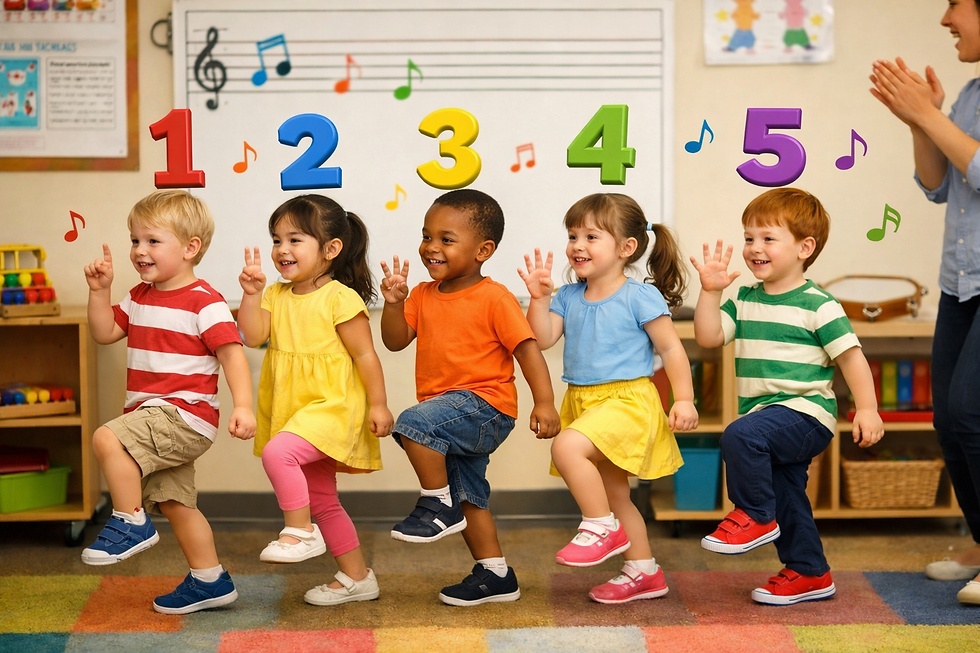
As a parent, I found that children who regularly sang number songs developed stronger number confidence than those who relied solely on counting worksheets. Music allowed them to “feel” numbers rather than fear them, which is essential for building a healthy relationship with math later on.
Moving beyond rote counting to a deeper understanding.
"Count to 100" (by Jack Hartmann): Energetic and clear, Jack's songs are classroom staples. This one breaks down the daunting task of counting to 100 into manageable, rhythmic chunks with movement breaks.
"Counting Together" (by The Laurie Berkner Band): A wonderfully interactive song that encourages call-and-response and varying speeds (fast! slow!), teaching control and fluency with numbers.
"The Ants Go Marching": An epic counting adventure! It reinforces number order, introduces new vocabulary ("suck his thumb," "tie his shoe"), and is just plain fun with its marching rhythm.
Songs That Combine Colours AND Numbers (The Ultimate Combo!)

These are the gold standard for integrated Learning.
"Five Green and Speckled Frogs": A masterclass in early math. It combines counting down from five, the colour green, and a simple narrative. Using frog toys on a "log" (the couch) turns it into a captivating play.
"Ten Little Fishies" (or "Ten Little [Coloured] Bubbles" ): You can adapt this tune to feature any coloured object. "One little, two little, three little BLUE fishies." It's customisable to what your child loves.
"I Can Count My Colours" (A DIY Song): Use the tune of "Twinkle, Twinkle." Sing: "I can count the colours that I see. Red things, how many can there be? Let's look around and count them now: One red block, two red cups, wow!" This empowers you to use their own environment.
How to Make the Music Stick: Pro-Tips from a Teacher & Mom

Simply playing the songs isn't enough. Here's how to maximise the Learning:
Be the Visual: Use your hands! Hold up fingers when counting. Point to objects of the colour you're singing about. Your engagement is the most powerful tool.
Create a "Learning Basket": Keep a basket with props near where you usually sing: colored scarves, a set of counting bears, number flashcards, toy frogs. Let your child grab props as the song plays.
Pause and Predict: In a familiar song, pause before the next number or colour. "Five little ducks went out one day over the hills and far away. Mama duck said, 'Quack, quack, quack, quack' and how many ducks came back?" Let them fill in the blank.
Connect it to Real Life: After singing "The Colour Song," go on a red scavenger hunt around the house. After "Five Little Monkeys," count out five banana slices at snack time. This bridges the gap between the song and their world.
Make it a Ritual: Weave these songs into your day. Have a "clean-up counting song" (count toys as they go in the bin), a "colour-of-the-day" song at breakfast, or a calm counting song as part of your bedtime routine. Consistency is key.
When I make or choose out learning tunes, I follow this basic rule: if the song makes the child feel stressed or rushed, it's not helping them. It should be fun and safe to learn. Children's minds are far more susceptible to learning new things when they are calm.
To make this even easier to use at home, I created a simple,👉 printable activity that turns these songs into hands-on learning.
This printable helps toddlers and preschoolers practice colours and numbers through singing, counting, and colouring no prep required.

At Kids Songs Learning Hub, our mission has always been to make learning joyful through music not pressured, not forced, and never boring. Every song we create or recommend is designed with real children in mind, tested in real homes and classrooms, and refined based on how kids actually respond, not how adults think they “should” learn.

Remember, the goal isn't perfection. It's connection. Your off-key singing is the sweetest sound to your child because it's yours. When you sit on the floor and sing about colours and numbers, you're doing so much more than teaching. You're saying, "Learning is joyful. Exploring is fun. And I'm right here with you."
So, take a deep breath, press play on one of these songs to teach kids colours and numbers, and get ready for the magic to happen. You've got this.
What's the song that made colours or numbers "click" for your child? I'd love to hear your family's favourite in the comments below!
About the Author
Janerine Watson is the founder of Kids Songs Learning Hub and a mother of three. She holds a BSc in Health and Social Care and discovered through raising her own children that music is one of the most effective tools for helping toddlers listen, cooperate, and thrive. When she's not researching songs, you'll find her covered in toddler finger paint and singing along.
Disclaimer:
This article's information is only for learning and informational reasons. It is not meant to take the place of professional medical, developmental, or educational guidance. Each youngster grows and learns at their own speed. If you're worried about your child's speech, learning, or development, please talk to a skilled pediatrician, early childhood educator, or child development expert. Kids Songs Learning Hub does not offer medical or therapeutic services.


Comments