Summer Sensory Play Ideas for Toddlers: Sand, Water, Music and Safe Outdoor Fun
Updated: Jul 8
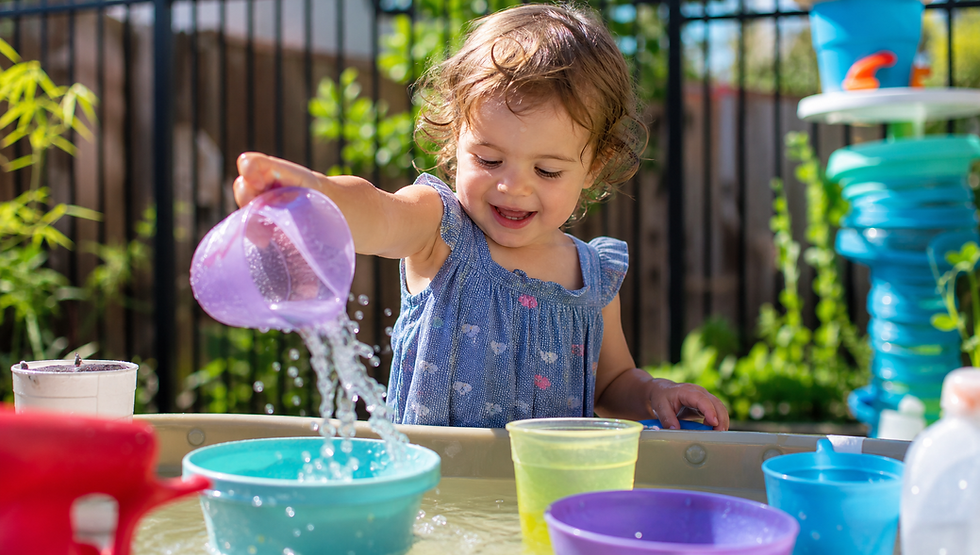
Summer is a lovely time for toddlers to explore with their hands, feet, eyes, ears, and whole bodies. A bowl of water, a tray of sand, a few cups, a simple song, or a walk in the garden can become a rich learning moment without needing expensive toys or complicated plans.
I’m Janerine Watson, founder of Kids Songs Learning Hub, a mother of three, and a BSc Health and Social Care graduate. Some of my favourite toddler learning moments have happened during the simplest activities: pouring water, scooping sand, listening to rain, tapping a wooden spoon, or singing a little song while a child explores.
Sensory play does not need to be perfect. It does not need to look like a beautiful social media setup. It just needs to be safe, supervised, age-appropriate, and open enough for your child to explore.
This guide shares summer sensory play ideas for toddlers using sand, water, music, ice, nature, and texture. Each activity includes a song idea, learning moment, and safety note.
Important Safety Note Before You Start
Always supervise toddlers closely during sensory play, especially around water, sand, small objects, food-based materials, ice, outdoor spaces, and messy play.
Young children may put objects in their mouths. Avoid small items, coins, beads, buttons, small stones, small shells, magnets, batteries, broken toys, loose craft pieces, and anything that could be a choking hazard.
For water play, stay within arm’s reach, use shallow water only, and empty bowls, buckets, trays, and paddling pools immediately after use. RoSPA warns that young children can drown in very small amounts of water.
If your child has allergies, eczema, sensory processing differences, medical needs, developmental needs, or strong reactions to textures, adapt activities carefully and speak with a qualified professional if you are unsure.
Why Sensory Play Can Be Helpful for Toddlers
Sensory play gives toddlers a chance to explore the world through real experiences. They can pour, splash, scoop, squeeze, tap, listen, smell, touch, compare, and move.
Simple sensory play can help children practise:
Fine motor skills
Hand strength
New words
Listening
Counting
Cause and effect
Turn-taking
Problem-solving
Body awareness
Calm focus
NHS guidance recommends that toddlers and preschool children have plenty of varied physical activity across the day, including active and outdoor play. Sensory play can be one simple way to help children move, explore, and stay engaged.
Why Add Music to Sensory Play?
Songs can make sensory play more meaningful because they give children words for what they are doing.
When a toddler pours water, you can sing about rain. When they scoop sand, you can sing a digging song. When they tap a pot, you can sing a rhythm chant.
Music can help children:
Hear repeated words
Connect actions with language
Follow simple routines
Stay engaged
Remember the activity
Join in through clapping, tapping, humming, or movement
You do not need to sing perfectly. Your familiar voice is enough.
1. Simple Water Pouring Station

Water pouring is one of the easiest summer sensory activities. Set out a shallow bowl or tray with cups, spoons, and containers of different sizes.
You need
A shallow bowl or tray
Water
Cups
Spoons
A towel
How to play
Let your toddler pour water from one cup to another. Use words like full, empty, more, less, spill, splash, heavy, and light.
Song to sing
Pour, pour, little cup,
Fill it down and fill it up.
Splash, splash, one, two, three,
Water play for you and me.
Learning moment
This activity supports pouring, hand control, simple maths words, and cause and effect.
Safety note
Never leave your toddler alone with water, even shallow water. Empty all containers immediately after play.
2. Sand Scoop and Fill
Sand play is simple, calming for many children, and easy to repeat. Use clean play sand in a tray, sandpit, or large container.
You need
Clean play sand
Large scoops
Cups
Buckets
How to play
Let your child scoop, fill, empty, pat, and pour. Name what they are doing as they play.
Words to practise
sand, scoop, fill, empty, heavy, soft, dry, wet, bucket
Song to sing
Scoop the sand and fill the cup,
Tip it out and build it up.
Dig, dig, one, two, three,
Sandy play for you and me.
Learning moment
This supports hand strength, texture words, early maths, and pretend play.
Safety note
Use clean play sand, not builder’s sand. Check for sharp objects before play. Do not bury small items for toddlers who may mouth objects.

3. Sand Pattern Tray
A sand pattern tray is a lovely pre-writing activity. Spread a thin layer of sand in a tray and let your child make marks with fingers or a large safe tool.
You need
Dry play sand
A tray
Finger, spoon handle, or large safe stick
How to play
Draw lines, circles, waves, faces, or simple shapes. Smooth the sand and start again.
Song to sing
Round and round the circle goes,
Where it stops, nobody knows.
Line by line and wave by wave,
Look at all the marks we made.
Learning moment
This supports early mark-making, shape words, finger movement, and creativity.
Safety note
Supervise closely and stop if your child throws sand or tries to eat it.
4. Nature Sound Hunt
A nature sound hunt is sensory play for the ears. Go outside and listen quietly.
You might hear
Birds
Wind
Cars
Dogs
Footsteps
Rain
Leaves
How to play
Ask, “What can we hear?” Copy the sounds together.
Song to sing
I hear birds go tweet, tweet, tweet,
I hear footsteps on the street.
I hear leaves go swish, swish, swish,
What sound will we hear next?
Learning moment
This supports listening, sound copying, attention, and vocabulary.
Safety note
Stay close to your toddler outdoors, especially near roads, water, pets, plants, or uneven ground.
5. Colour Mixing Water Play
Colour mixing is a simple visual sensory activity. Use water with a tiny amount of food colouring in clear cups.
You need
Clear cups
Water
Food colouring
Spoons or droppers
How to play
Mix two colours and watch what happens. Say the colours as they change.
Song to sing
Red and yellow, what do we see?
A new colour made by me.
Blue and yellow, stir once more,
Colours changing, let’s explore.
Learning moment
This supports colour words, observation, prediction, and cause and effect.
Safety note
Food colouring can stain. Use old clothes, protect surfaces, and supervise closely. Do not let children drink the coloured water.
6. Foam Play With Caution
Foam can be fun for toddlers who do not mouth materials. You can use child-friendly bubble bath foam in a tray with cups and spoons.
You need
Bubble bath foam
Water
Tray
Cups and spoons
How to play
Let your child scoop and move the foam. Use words like soft, bubbly, light, white, wet, and slippery.
Song to sing
Bubble, bubble, soft and light,
Scoop it gently, fluffy white.
Round and round the bubbles go,
Foamy play from high to low.
Learning moment
This supports texture words, scooping, sensory exploration, and hand movement.
Safety note
Do not use foam with children who still mouth objects or materials. Avoid eyes and mouth. Stop if skin becomes irritated.
7. Kitchen Drum Circle
Music is sensory play too. Use safe household items to explore sounds.
You need
Wooden spoon
Plastic bowl
Cardboard box
Metal pan, if suitable and not too loud
How to play
Tap different surfaces and listen to the sounds. Try loud, quiet, fast, and slow.
Song to sing
Tap, tap, tap the beat,
Tap your hands and tap your feet.
Loud then quiet, fast then slow,
Little drummer, here we go.
Learning moment
This supports rhythm, listening, turn-taking, and sound awareness.
Safety note
Keep sounds at a comfortable volume. Avoid glass, sharp items, heavy pans that could fall, or anything that could hurt hands.
8. Move Like the Music
Play different types of music and invite your toddler to move.
Try movements like
March
Sway
Tiptoe
Clap
Freeze
Stretch
How to play
Use one song for fast movement and one for slow movement.
Song to sing
Fast feet, slow feet, moving to the sound,
Clap your hands and turn around.
High hands, low hands, freeze and stay,
Music tells our bodies how to play.
Learning moment
This supports movement, listening, body awareness, and self-control.
Safety note
Clear the floor first. Avoid slippery socks, stairs, hard corners, and crowded spaces.
9. Safe Sound Shakers
Instead of using tiny loose items in containers that can open, make adult-sealed shakers with larger safe materials inside a secure bottle.
You need
Secure plastic bottle
Tape to seal the lid
Large dry pasta or safe filling
How to play
Shake the bottle, tap the rhythm, and listen to the sound.
Song to sing
Shake, shake, shake today,
Shake the sound and hear it play.
Fast and slow, loud and light,
Shaker sounds are bright.
Learning moment
This supports rhythm, listening, sound comparison, and hand movement.
Safety note
Adults must make and seal shakers. Check before every use. Do not use if the lid loosens. Keep small loose fillings away from toddlers.
10. Ice Discovery Tray
Ice play can be exciting in summer. Freeze larger toddler-safe objects in ice, then let your child melt the ice with warm water.
You need
Ice tray or container
Large toddler-safe objects
Warm water
Spoon or dropper
How to play
Let your toddler drip warm water onto the ice and watch it melt.
Song to sing
Cold ice, warm water, drip, drip, drip,
Melting slowly, slip, slip, slip.
What is hiding? Wait and see,
Ice surprise for you and me.
Learning moment
This supports science words like cold, warm, hard, melt, wet, and inside.
Safety note
Do not freeze coins, beads, tiny toys, magnets, batteries, or small choking hazards. Use warm water, not hot water. Supervise closely.
11. Ice Painting

Make ice paint using water and a little food colouring. Freeze in large shapes with adult-safe handles if needed.
You need
Ice cubes or large ice shapes
Food colouring
Large paper
Tray
How to play
Move the coloured ice across paper and watch marks appear as it melts.
Song to sing
Cold colours slide and glide,
Making marks from side to side.
Blue and red and yellow too,
Icy art made by you.
Learning moment
This supports colour words, temperature words, mark-making, and observation.
Safety note
Supervise closely. Stop if your child mouths the ice. Food colouring may stain hands and clothes.
12. Nature Texture Walk
A texture walk helps toddlers notice how the world feels.
Look for
Soft grass
Smooth stones
Rough bark
Cool shade
Dry leaves
Warm path
How to play
Let your child touch safe textures with hands. Name each texture.
Song to sing
Soft and rough and smooth today,
Textures found along the way.
Touch it gently, name it too,
Nature has a lot to do.
Learning moment
This supports descriptive words, nature connection, and sensory awareness.
Safety note
Avoid poisonous plants, unknown berries, mushrooms, sharp sticks, insects, animal mess, broken glass, and unsafe surfaces. Wash hands after outdoor play.
13. Summer Sensory Bin
A sensory bin can be simple. Use large, safe, age-appropriate materials.
Safe ideas may include
Large fabric squares
Large plastic animals
Large scoops
Large shells for older children only
Paper grass
How to play
Let your child scoop, sort, hide, find, and pretend.
Song to sing
What is hiding in the tray?
What shall we find today?
Scoop and look, one, two, three,
A sensory surprise for me.
Learning moment
This supports pretend play, vocabulary, sorting, and exploration.
Safety note
Avoid small objects for toddlers. If an object fits inside a toilet roll tube, it is too small for children under 3.
14. Texture Painting
Texture painting lets children explore how different tools feel and mark.
You need
Child-friendly washable paint
Large paper
Sponges
Cardboard tubes
Large leaves
How to play
Let your child paint with different tools and talk about the marks.
Song to sing
Dab, dab, swish and slide,
Paint the paper side to side.
Soft sponge, leaf so green,
What lovely marks can be seen.
Learning moment
This supports creative expression, texture words, hand control, and cause and effect.
Safety note
Use washable child-friendly paint. Avoid small parts, sharp items, and tools that may scratch skin. Supervise closely.
15. Herb Smell Station
A smell station is a gentle sensory activity. Use herbs such as mint, basil, rosemary, or lavender if suitable for your family.
You need
Fresh herbs
Small bowls
A tray
How to play
Let your child smell each herb and choose a favourite.
Song to sing
Mint smells fresh and basil too,
What smell is nice for you?
Sniff it gently, name it slow,
Summer scents help words grow.
Learning moment
This supports smell words, memory, preference language, and vocabulary.
Safety note
Check allergies and skin sensitivity. Do not let children eat unknown herbs or plants. Supervise closely and wash hands after.
Age Guide for Summer Sensory Play
Age | Good activities | Focus |
12 to 18 months | Water pouring, sound hunt, simple music play, large texture play | Safe exploration and simple words |
18 to 24 months | Sand scoop, foam play if not mouthing, colour water, movement songs | Action words and cause and effect |
2 to 3 years | Ice discovery, sensory bins, texture walks, rhythm play | Vocabulary, prediction, and simple choices |
3 to 4 years | Sand patterns, ice painting, matching sounds, texture painting | Describing, comparing, and pretend play |
4 to 5 years | More detailed sensory bins, nature boards, simple recording pages | Storytelling, early science, and longer focus |
Every child is different. Use this as a guide, not a rule.
Quick Safety Checklist
Before starting sensory play, check:
Is the activity supervised?
Are all items too large to choke on?
Is water shallow and closely watched?
Are materials safe for a child who mouths objects?
Are allergies or skin sensitivities considered?
Are sharp, hot, breakable, magnetic, battery-powered, or tiny items removed?
Is the area easy to clean?
Can the activity be stopped quickly if needed?
Child Accident Prevention Trust warns that babies and toddlers are at higher risk from small parts, button batteries, magnets, chemicals, and unsafe toys because they naturally put things in their mouths.
Five-Minute Sensory Play Ideas for Difficult Days
Some days you do not have energy for a full setup. Try one of these quick ideas.
1. Cup and spoon water play
Use a shallow bowl, one cup, and one spoon.
2. Texture basket
Add a soft cloth, sponge, wooden spoon, and plastic cup.
3. Sound walk
Open the window or step outside and listen for three sounds.
4. Crayon texture rubbing
Place paper over a leaf and rub with a crayon.
5. Song and movement break
Play one song and move like rain, wind, sunshine, or waves.
Keep it short. Five minutes still counts.
How to Make Sensory Play Less Stressful
Prepare first
Set up the tray before inviting your child.
Use old clothes
Mess is easier when you are ready for it.
Keep materials simple
Water, sand, cups, spoons, paper, and music are enough.
Let your child lead
If they use the material differently from your plan, that is often part of the learning.
Add language
Say what you see:
“You poured the water.”
“The cup is full.”
“The ice feels cold.”
“The sand is soft.”
Repeat activities
Toddlers often learn more deeply by repeating the same activity many times.
Frequently Asked Questions
What is sensory play for toddlers?
Sensory play is any safe activity that lets children explore through touch, sight, sound, smell, movement, or taste. Examples include water play, sand play, music play, texture walks, ice play, and simple messy play.
Is sensory play good for toddlers?
Sensory play can be a helpful part of toddler development because it gives children chances to explore, move, talk, compare, listen, and use their hands. It should always be safe, supervised, and age-appropriate.
How long should sensory play last?
Follow your child’s interest. Some toddlers play for five minutes. Others stay interested for much longer. Short, repeated activities are often enough.
What if my toddler hates messy play?
Do not force it. Start with less messy textures such as dry fabric, large smooth toys, water in a cup, or music movement. Let your child use tools like spoons before touching with hands.
Can sensory play help children with sensory processing differences?
Some families use sensory activities as part of everyday play, but children with sensory processing differences may need individual support. If you are concerned, speak with an occupational therapist, health visitor, GP, or another qualified professional.
Is water play safe for toddlers?
Water play can be safe only with close adult supervision. Use shallow water, stay nearby, empty containers after play, and never leave a toddler alone near water.
Do I need special sensory toys?
No. Many sensory activities use simple household items such as cups, spoons, bowls, paper, water, safe fabric, and music.
Free Printable: Summer Sensory Play Activity Cards
To make this guide easier to use, add a free printable called Summer Sensory Play Activity Cards.
Inside the printable, include:
✓ Water pouring card
✓ Sand scoop card
✓ Nature sound hunt card
✓ Colour mixing card
✓ Kitchen drum card
✓ Ice discovery card
✓ Texture walk card
✓ Sensory safety checklist
✓ My favourite sensory activity page
👉Download Summer Sensory Play Activity Cards
Helpful Related Resources
For more summer ideas, read 20 Best Summer Activities for Toddlers That Don’t Involve a Screen.
For music and movement play, read Christmas Songs for Toddlers and Preschoolers if you are planning seasonal activities.
For toddler language play, read How Music Helps Toddlers Learn Language.
For free printables, visit the Free Preschool Printables Library.
Final Thoughts
Summer sensory play does not need to be complicated. A bowl of water, a tray of sand, a simple song, or a walk outside can give toddlers rich opportunities to explore.
Start with one activity. Keep it safe. Add a song. Watch what your child does. Name what they discover.
Sometimes the best learning happens when little hands are full of sand, water, music, and wonder.
About the Author
Janerine Watson is the founder of Kids Songs Learning Hub, a mother of three, and a BSc Health and Social Care graduate. She creates music-based learning resources, children’s songs, printable activities, and parent-friendly guides that help toddlers and preschoolers learn through rhythm, repetition, movement, routines, and play.
Through parenting and her background in health and social care, Janerine shares practical ways families can make sensory play, summer activities, music, and everyday learning moments more playful, realistic, and easier to repeat.
Child Safety and Sensory Play Disclaimer
This article is for general family activity, music, and early learning purposes only. It is not medical, developmental, childcare, occupational therapy, sensory integration therapy, speech and language therapy, water safety, allergy, or professional safety advice.
Every child is different. Adapt activities for age, development, allergies, sensory needs, mobility, communication, attention, mouthing behaviour, and family circumstances.
Always supervise toddlers during sensory play. Keep small objects, coins, beads, buttons, small stones, small shells, magnets, button batteries, cords, sharp tools, broken toys, unsafe plants, chemicals, hot water, deep water, and choking hazards away from young children.
Water play must be supervised closely at all times. Use shallow water only and empty containers immediately after play. Outdoor activities should be adapted for weather, sun, heat, insects, plants, surfaces, and safe surroundings.
If your child is unwell, injured, choking, has trouble breathing, swallows an unsafe object, battery, magnet, plant, or substance, or you are seriously worried, seek urgent medical advice.
Sources and useful guidance
NHS: Physical activity guidelines for children under 5
RoSPA: Garden safety and water safety
Child Accident Prevention Trust: Toy safety and choking prevention


Comments